Glen Davis - Capertree Valley

Glen Davis

Glen Davis is not a well known town in regional New South Wales. It is located in the Capertee Valley and is about a three and half hour drive from Sydney.

In its former life Glen Davis was home to a workforce of two and a half thousand men working in the shale oil industry.

The industry was established in the late 1930s to reduce Australia’s dependence on overseas oil as a world war loomed.

The shale oil plant at Glen Davis was never profitable and these activities ceased in the 1950s.

The town’s name originates from industrialist George Davis, who was a driving force in setting up shale oil operations at Glen Davis.

The word ‘glen’ is a Scottish word for valley and has been applied in a number of countries to name places. It is also used in naming a nearby town, Glen Alice.

Remnants of the shale oil works still remain in Glen Davis and can be seen from a lookout at their rear of the site. Take a left onto Goora St, just before the town and follow the road eastwards.

The Glen Davis lookout is located at the back of the decaying shale oil buildings and plant.

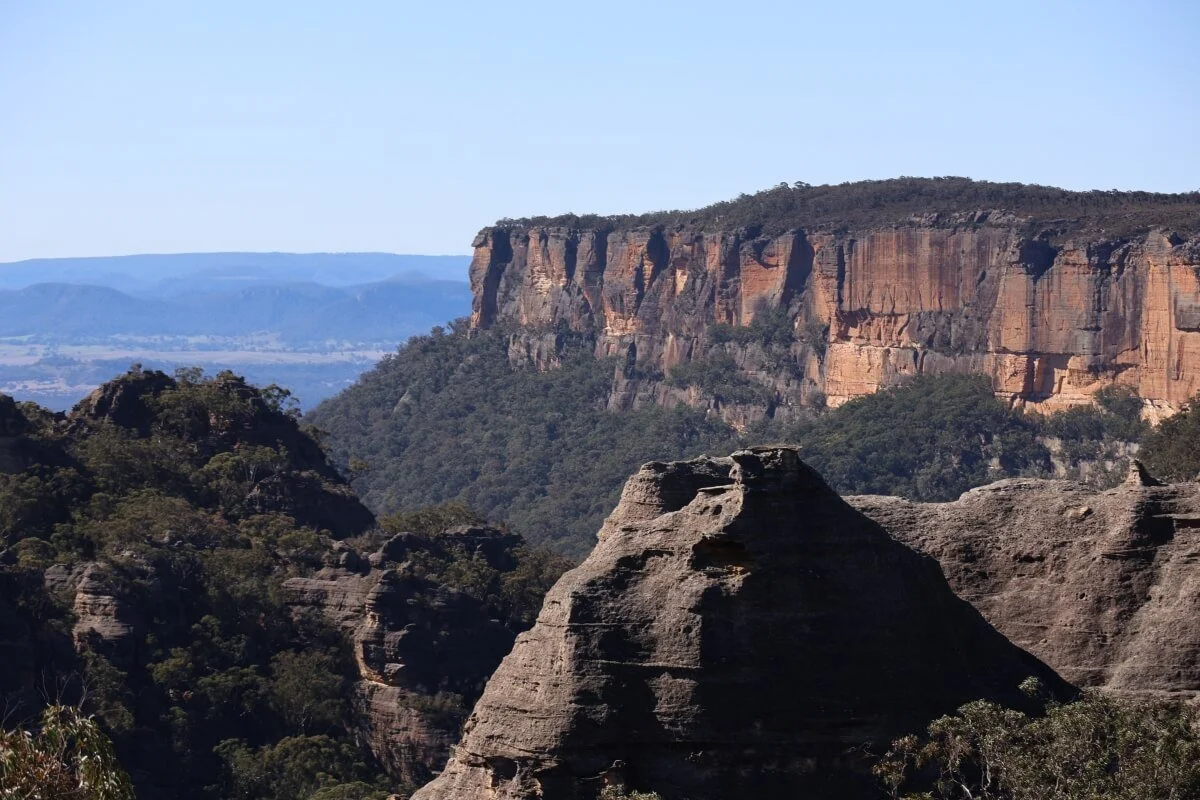
The easy walk up to the lookout provides a great view of not only the plant but the valley and surrounding sandstone cliffs and hills.

A few small ruined brick buildings also exist at the lookout itself along with some discarded industrial items.

As you drive around the small town of Glen Davis you may notice an Ampol logo from the 1950s, a red winged horse.

It is painted on a white wall and is in surprisingly good condition. In front of it is an abandoned petrol bowser.

If you brought your lunch and you need to as there are no shops, enjoy it on the shaded seats in front of the community centre.

This quaint and forgotten town has grand surrounds and is well worth a visit. It is also a reminder of a chapter in Australia’s history.

shale oil plant ruins

discarded heavy duty cabling - not your usual tourist attraction!

Capertee River

striking sandstone surrounds Glen Davis

Go the flying red horse

Capertee Valley wonder

Pantoney’s Crown can be seen from Glen Davis Rd as you head toward Glen Davis - well worth a stop to appreciate its majesty

The Royal National Park - the Botany Bay diamond weevil

The Botany Bay Diamond Weevil (BBDW) generally comes in either green or blue mixed with black.

Whilst walking to one of gems in the Royal National Park, Eagle Rock, we had the pleasure of acquainting

ourselves with this little bug.

A chequered pattern of black and aqua made it stand out in the bush even though it is small (up to

2.5cms).

It is exciting to come across a new insect, particularly a striking one.

The BBDW was one of the first insects identified in the Botany Bay area by First Fleet Botanist, Joseph Banks.

A weevil is a type of beetle, which are known for their elongated snouts,

The snouts allow the weevil to chew holes in plants for food and to make holes for egg chambers.

It’s all about the snout

Love this place - good seating, plenty to eat

Sydney’s Northern Beaches - dolphins, big swell at Avalon rockpool, a Sydney red gum at West Head

Sydney’s Northern Beaches - dolphins, big swell at Avalon rockpool, a Sydney red gum at West Head, Ku-ring-gai National Park

Two days ago Sydney Nimble was treated to the sight of a pod of dolphins playfully swimming and surfing waves at the northern end of Palm Beach.

They were spotted whilst walking near Barrenjoey Lighthouse. There were at least 14 dolphins in the grouping. A rare treat!

On the way back from Palm Beach the swell had picked up during the day. A few individuals had chanced their arm and bodies by swimming in the Avalon rockpool which was being bombed with foam from breaking waves. The brave swimmer(s) in two of the photos are clearly exposed to the power of ocean.

Next stop was West Head lookout where we came across a Sydney red gum (Angophora Costata) which was shedding it rich earthy-coloured bark.

The smooth barked Sydney red gum is a native of the east coast of Australia and is characterised by twisted and gnarly branches.

Summer is a great time to visit and enjoy the beauty of the Northern Beaches and Ku-ring-gai Chase National Park!

dolphin line up

Sydney Spring Native Wildflowers in The Royal National Park

We are well into Spring and the Royal National Park’s native plants are producing some splendid flowers.

A few of the most spectacular wildflowers seen whilst walking on coastal tracks include the Drumstick, Gymea Lily and Waratah.

Two varieties of Drumstick are the Broad-leaf Drumstick and the Narrow-leaf Drumstick.

Bright yellow flowers are common to both species with the Broad-leafed Drumstick having leaves that are flat and fork-like whilst the leaves of the Narrow-leafed Drumstick are needle-like in appearance.

The first photo below of a Narrow-leafed Drumstick shows the delightful purple tinges that may appear prior to flowering on the spherical fruiting body.

If you look closely at the photo there is a spiraling pattern of thorn shaped purple hairs.

Over time the fruiting body which is at the end of the small branches will turn grey in colour and develop a barrel or cone shape resulting in the plant being named a drumstick.

Gymea Lilies are very different to other plants in the Royal National Park and can be seen in many places as you drive through the park.

These plants are native to the Sydney region, sending up long narrow green shoots that reach several or more metres and are topped with a striking red flower.

A third wildflower we came across whilst walking on the Curra Moors Track to Eagle Rock, is the Waratah.

The Waratah is the floral emblem of New South Wales, having a vivid red-pink flower which grows in the state’s bush in clumps of tall stems.

In the second last photo the small attractive red/pink and white bell shaped flowers of the Fushia Heath are in the foreground.

The white flowers of the Heath Myrtle can be seen in the background.

pre-flowering purple power of a Thin-leafed Drumstick

Broad-leaf Drumstick and insects

Flaming red flowers of the Gymea Lily

Waratahs on the Curra Moors Track

Fushia Heath and Heath Myrtle

An explosion of colour on the track to Wedding Cake Rock

Callistemon pachyphyllus Green - a bottlebrush with a fantastic lime green flower

A new forest walk in the Royal National Park

Forest Track

Sydney Nimble has added a new bush walk to its Royal National Park Tour.

Unlike some of our coastal walks through heathland (Wedding Cake Rock and Eagle Rock), the Forest Track offers a chance to see a very different environment in the national park.

Part of the walk is through a forest whilst the second half moves into a rainforest.

The track is a loop track so you finish within 50 metres of where you started. The track takes the rough shape of a loop as it follows and stays inside of Bola Creek and the Hacking River.

The range of vegetation is diverse and interesting.

There is a small patch of large Gymea Lilies where the sword like leaves are exceptionally high. Can’t wait for these plants to bloom with long shoots and wonderful red flowers on the end.

There are many cabbage tree palms of varying sizes, some as high as 25 metres, maybe more. Sorry didn’t bring the tape measure!

One of the real treats is coming across tall red cedar trees.

These trees were saved from loggers in the 1920s after community protest. In view of the high value of the timber from red cedar trees the trees were known as red gold. There’s gold in them there hills!

Attached to some trees are epithytes, which are plants that do not put down roots on the ground but instead have roots located on another plant or tree.

This allows the epithyte to exist closer to the forest’s canopy and obtain access to better quality light.

Unlike a parasite an epithyte does not take nutrients from the tree. It will instead rely on airborne nutrients, rain for water and compost on tree branches to survive.

Two attractive epithytes that can be seen on the Forest Track are the bird nest and staghorn ferns (first two pictures below).

There is fungi (check out third photo), lichen and much plant life to see when you walk through the rainforest: bright green moss on logs and boulders, epithytes, hollow trees, ferns, palms, eucalypts, casuarinas, red cedar trees and lianas.

Lianas are long stemmed woody vines that use trees and other means to make there way upwards to the rainforest canopy in search of sunlight.

if you are lucky you may come across a lyre bird whilst walking on the forest path.

Lyre birds are a native Australian bird which have the incredible capacity to mimic other birds and animals. They have also been known to imitate human sounds and sounds made by machines.  

The Forest Track takes around an hour and half to walk and Sydney Nimble is delighted to include it in our Sydney Tours.

high and healthy staghorn ferns

thriving bird nest ferns

Fungi (Hygocybe erythocrenata) encountered on the Forest Track

dont trip on the liana, it moves for no one

lyre bird on the move

hollowed out tree

tall timber

Aussie Ark, Muswellbrook and Burning Mountain

Why

Sydney Nimble recently went beyond day tour range and visited Muswellbrook, Aussie Ark and Burning Mountain.

The plan is to identify new places for a two or three day tour.  

Only the best will do!

Aussie Ark was identified as a ‘place of interest’. It is located in Barrington Tops.

Muswellbrook was chosen as a staging post from which to visit Aussie Ark as access is not currently available from Gloucester due to a landslide.

Burning Mountain came onto the radar after extensive researching of potential walks in Muswellbrook and nearby areas, that do not exceed 2 hours duration.

Muswellbrook wildlife of the flying kind

The spectacle that most captured our attention in Muswellbrook was the incredible number of flying foxes that had chosen to reside in the trees at the rear of our accommodation (The Remington).

It was hard to estimate their numbers but it is likely there were at least a thousand bats, maybe a lot more. A number of the trees were saturated with bats (see first photo).

Although bats generally make sounds that are too higher a pitch for humans to hear, the bats in the morning were making audible eerie high pitched calls, possibly indicating it was time to fly out.

Aussie Ark

It takes around two hours to drive to Aussie Ark from Muswellbrook but it could easily take longer if you stopped to enjoy some of the wonderful scenery.

On the drive through you will also come across the small country towns of Gundy and Moonan Flat, whilst there is a never ending parade of green hills and mountains, and the occasional volcanic cone.

For a Sunday morning the local pub in Gundy was busy on the outside lawns. Five stars for the name, Linga Longa Inn Hotel.

Having arrived at Aussie Ark we were ready for a two and a half hour Devils in the Wild Tour.

Aussie Ark’s vision is to create a long term future for threatened Australian species and it does this by providing secure sanctuaries for native wildlife.

As expected the stars of the show were the Tasmanian Devils and they become even more amazing when they gather as a group. This usually only occurs around feeding or mating time.  

Watching them devour a kangaroo is something not easily forgotten.

Various grunts and other noises are made by the devils when they literally tear the kangaroo apart. Flesh, organs, bone, muscle and fur are all eaten – nothing is left.

Another animal that is also a delight to see is the Eastern Quoll with its long tail and inquisitive look. These marsupials have a dark thick coat marked with roundish white spots.

A Potoroo encounter was also enjoyed with the Potoroo showing a lot of interest in the shoes of all visitors.

At the end of the tour we had the pleasure of meeting Rufous the Bettong. Initially he was a little reluctant to meet the group finding the nearby kitchen a more amenable place to hang out.

However he did warm to us and once in the mood was happy to be picked up and loved by adoring Bettong groupies.  

Aussie Ark is thoroughly worth the time and effort to visit. Highly recommended.

Burning Mountain

Burning Mountain (Mt Wingen) is located between Scone and Murrurundi.

A 30 metre underground coal seam is slowly burning, which according to estimates was lighted at least 5500 years ago.  

Once at the location you are likely to smell sulphurous smoke and see rocks bleached white from the heat.

On our visit we did not however see a lot of smoke just a few small wisps were observed from one or two rocks near the crest of the hill.

On the way to Burning Mountain a kangaroo bounded past at speed and we did see a few other kangaroos in nearby bush.

All in all an interesting walk with district views and a very unusual natural phenomena at the end.

New Tour

A visit to Aussie Ark will provide much joy If you like native animals and attractive scenery.

We combined it with a walk to Burning Mountain and a short visit to the Hunter Valley on the way.

A three day tour to this region is still being considered.

Alternatively take yourself on a mini driving holiday from Sydney. Allow around three days.

how many flying foxes can hang on a tree - a lot!

black and brown and never a frown

grand countryside

friend or foe - neither, the yawn is a sign of uncertainty or fear

making a meal of it

Shameless

Eastern quoll

how scorched is my earth

The panoramic Grose Valley in the Blue Mountains

We often stop at the spectacular Grose Valley on our Blue Mountains tour which showcases canyons, ravines, plateaus, creeks, waterfalls, massive cliff faces and the Grose River. Three of the best lookout spots are: Evans Lookout, Govetts Leap and Walls Lookout.

Access to Evans Lookout and Govetts Leap can be obtained by driving to the nearby car park whilst Walls Lookout requires a bushwalk.

The magnificent geology of the Grose Valley was created by uplift and erosion. The valley is covered by dense Eucalyptus Forest.

A recent feature of the Grose Valley, which was created in March 2021, is a carve out in the sandstone cliff face below Lockleys Pylon.

The ‘rock carving’ resulted from a rockfall which was greatly assisted by intense rainfall running off the plateau above.

The rain dump on the Blue Mountains and Sydney generally in 2021 and 2022 has been attributable to the La Nina weather phenomena.

What makes the shape created by the rockfall so noticeable is that it has the appearance of a fish, but not one you would commonly think of.

It looks like a seahorse and yes seahorses are categorised as fish!

The Grose Valley is a place of exceptional beauty and the addition of a seahorse rock carving is yet another reason (not that one is needed) to drop by.

so big!

Bridal Veil Waterfall

Four happy souls at nearby Jamison Valley

Australian Wildlife Experiences - The Tasmanian Devil

An option on our Royal National Park private day tour is a visit to Symbio Wildlife Park where visitors can see a number of unique Aussie animals.

One of our favourites is the Tasmanian Devil, one of Australia's most well known native animals.

It is a marsupial, which is basically a mammal whose young are incompletely developed at birth and typically carried in a pouch.

They are only found in the wild in Tasmania, becoming extinct on the mainland around 3000 years ago.

When you look at the Tasmanian Devil’s head and face there are no devilish horns and the standout features include a moist black nose, many whiskers, dark deep eyes, two fang teeth near the corners of the mouth and large flappy ears.

The devil’s body has an attractive colouring of black fur with a white band running across the chest.

Their front legs are larger than their back legs which helps with climbing.

This difference in the front and back leg sizes can result in devils looking like they are galloping or skipping when they run.

A keen sense of smell allows devils to find fresh carcasses at night and they may travel many kilometres seeking out the recently deceased.

A great Australian scavenger story!

Devils are inquisitive and may look you directly in the eye, or just stand and sniff the air.

Tasmanian Devils have extremely strong jaws allowing them to eat all parts of an animal – fur, muscles, organs and bones. Nothing gets wasted.

Their dietary requirements do not go beyond the living or recently living and include wombats, kangaroos, rabbits, possums, birds and even insects. Plants need not apply.

The animals ears are unusual being pink in colour that will turn to purple colour if the devil is agitated.

So why then are these creatures called devils at all?

The answer lies in the noises they usually make at night, being primarily nocturnal.

Devils will ferociously fight each other over food or finding and keeping a mate, making growling, blood curdling noises in the process.

This behaviour explains their naming as a devil, but I would suggest a very likeable one. 

standing tall

Why does Sydney Nimble keep visiting me?

born to sniff at Symbio Wildlife Park

cute brute

90 Years Strong - The Sydney Harbour Bridge

Ninety years ago today (19/3/1932) the Sydney Harbour Bridge was officially opened.

Celebrations were organised to celebrate this milestone, which included light shows, a concert at Campbells Cove and vintage ferries and trains running during the day.

Historic double decker buses took passengers over the bridge from North Sydney to Wynyard and return for a number of hours.

Bridge climbers received a discount of $90. Strangely there were a lot of climbers on the bridge today!

The Sydney Harbour Bridge is one of those imposing structures that you never get sick of looking at when commuting across it.

It is too large and imposing to ever be ignored.

Happy birthday, Sydney Harbour Bridge.

What name should we give this bridge?

Why do they all have to sit upstairs?

grey sky, grey steel

And so they climbed, no not because of the discount, but because it’s there.

Natural pools in the Royal National Park - Olympic Pool & Karloo Pool

Olympic Pool has been on Sydney Nimble’s wish visit list for quite a while. Last Friday this desire was satisfied.

The conditions were highly suitable, warm weather and recent rains. It is best to visit after some rain as the pool will have a fresh flow of water.

We made our way to Olympic Pool after meeting at Heathcote Station and taking the track to Karloo Pool. The walk to Karloo takes about 50 minutes if you don’t stop.

Karloo Pool is a lovely freshwater pool and a good place to have a break.

The next leg of the journey requires following the twists and turns of the creek for quite a while until you reach Olympic Pool.

You may find that you have the pool to yourself as the solid walk to it reduces the enthusiasm of many adventurers.

Olympic Pool is a pleasant place to hang out having a few dips and maybe lunch in between. The green colouring of the water and reflection of the shrubs and trees on the water make for a pretty scene.

The pool’s name is based on its length which is similar, maybe longer, than the length of a 50 metre Olympic swimming pool. If your a swimmer bring goggles and do a few laps.

 Nothing like the feel of freshwater!

green and serene Olympic Pool

just walk off the rock into the refreshing green

capped and cool

tiny waterfall found on the way

pristine pool before OP

Sydney Opera House

The Sydney Opera House is located on a prominent point on Sydney Harbour and is a stone’s throw (maybe two) from the Sydney Harbour Bridge.

In 1957 Danish architect, Jorn Utzon, was chosen as the opera house architect from a field of over 200 contestants.

His design sketches were bold and inspiring. It was clear that the proposed building was going to be exceptional.

As with many ambitious plans reality kicked in and numerous modifications of the design were necessary.

This design process was pain staking and it was not until 1963 that the design was finalized.

The greatest challenge concerned the shape of the opera house’s most distinctive feature, large curved vaulted shells.

The shape had to have both structural integrity and the ability to be economically built.

Many shapes were tried ranging from parabolas to circular ribs to ellipsoids.

Ultimately the shape of the opera house’s shells was based on the dissection of a top of a sphere into segments.

One of the many interesting features of the opera house is that the shell walls curve and blend into the roof, joining at a central point.

Jorn Utzon did not want a flat roof and his desire for the opera house to be seen from all sides was satisfied by constructing the shells on an elevated platform (podium).

Due to the massive size of the shells the design had to allow for in situ construction, resulting in the shells being built piece by piece from precast concrete.

The final design chosen for the opera house is in the author’s opinion a significant enhancement of the original drawings, providing for a more upright and striking building, whilst still retaining the look of the original sketches.

Postscript

Whilst taking the photos for this blog Sydney Nimble came across the Sydney Opera Company’s principal soprano, Julie Lea Goodwin, who will be performing in the upcoming production of La Boheme at the Sydney Opera House.

Julie’s hair, make-up and art deco dress/ gown/ jewellery were exquisite. Nice to meet an opera singer at the opera house!

geometric shapes create an outstanding sculptural design

early afternoon light highlights zig zag patterns

art deco charm

the podium’s elevation vastly improves the display

Julie Lea Goodwin

Short tours from Sydney - Mudgee, Evans Crown, Ganguddy/Dunns Swamp, Rylstone & Pantoney's Crown

Most visitors to Sydney do not get past the day trip barrier. However, if you have time, a visit to regional NSW will provide some unique experiences.

In this small Summer adventure we headed to Mudgee and picked up Evans Crown on the way.

Evans Crown has powerful boulders of the granite kind (known by rockites, as Tors). Shake hands with your inner geologist and suck in the oxygen when you ascend many stairs and paths to the boulders. The walk takes around 25-35 minutes.

The good news is that the return trip is a lot easier. The first two photos below show the view at the top of this rocky outcrop.

Alternatively there are many canyon and bush walks to do around Lithgow, but do your research.

After Evans Crown we had a short stop at Sofala, which is a former gold mining town and quaint place to have a coffee break.

Further down the highway it is mandatory to pull over at Pearsons Lookout and take in the exceptional view of Pantoneys Crown.

We arrived at Mudgee later in the afternoon and stayed over night. Mudgee has some fine historical buildings, including a charming art deco cinema.

Although there are plenty of beckoning wineries in the Mudgee region, what attracted us most was a day trip to Rylstone and Ganguddy/Dunns Swamp.

The walk to the lookout at Ganguddy requires a bit of rock clambering at the end but is well worthwhile providing a stunning view of Pagoda central, with the added bonus of a hazy, meandering river in the foreground.

There is a lot to see outside of Sydney and Sydneysiders are taking up the options. Sydney Nimble Tours will be introducing a new two day tour of this area in coming months.


Massive granite boulders, the size is which is best appreciated by getting up close and personal.

rolling hills

Couldn’t resist including this photo, you don’t get businesses using these words anymore.

Ganguddy Swamp

Ganguddy Swamp

Pantoneys Crown is a wonderful site on the way to Mudgee

Pantoneys Crown is a wonderful site on the way to Mudgee

Sydney landmark - El Alamein Fountain, Kings Cross

A popular stop on our custom and eastern suburbs tours is the El Alamein Fountain in Kings Cross.

You may wonder why a fountain at Kings Cross brings on a discussion of World War II. The simple answer is that the El Alamein fountain commemorates two battles fought in World War II near the Egyptian town of El Alamein. More than 1200 Australian infantrymen lost their lives in the El Alamein battles which stopped the Axis forces (German and Italian armies) from taking over Northern Africa. It was a major turning point in the war. Winston Churchill described the siginificance of the El Alamein battles in the following way:

Before Alamein we never had a victory. After Alamein we never had a defeat.

The El Alamein Fountain was designed by Robert Woodward, who worked as an armourer in WW II.

The design of the fountain was inspired by the shape of a dandelion and the frame is comprised of 211 radially dispersed stalks. The stalks shoot out water which creates a bubbly or saucer like film. Wind conditions and direct sunlight will change the look of what you see. Water from the fountain overflows into several layered pools. It is a masterful modernist fountain and highly eye catching should you be walking or driving by. A wonderful mist is created when the fountain is firing. The construction of the El Alamein Fountain was completed in 1961.

Happy 60th birthday El Alamein Fountain!

pigeon paradise

inspiration

under the bonnet

mist monster

Beautiful Capertee Valley - a two day tour from Sydney

Sydney Nimble Tours has continued its quest to identify new locations to visit outside of Sydney. Our goal is to find the best places within four hours of Sydney.

This extended radius opens up many areas we have not previously considered.

With this in mind we visited the Capertee Valley and stayed two nights.

The Capertee Valley is the world’s second largest canyon, and can only be described as extraordinary.

When you drive through it you will see numerous majestic mountains, cliffs and stone pagodas. I thought to myself why haven’t I been here before?

The valley also includes the remarkable butte, Pantoneys Crown.

We were fortunate enough to stay with friends who really knew the area and took us on bushwalks that showed just how beautiful this region is. Many thanks to Duncan!

The Capertee Valley is bordered by and encompasses several national parks. The valley is a highly rated bird watching area and we were treated to the sight of a soaring wedge tailed eagle.

You may also come across kangaroos, wallabies and wombats in one of the valley’s national parks.

In addition to the flora and fauna the region also has some delightful small caves, pure freshwater streams and creeks plus many ‘out there’ geological formations.

We plan to include a visit to the Capertee Valley in our next extended tour which will focus on the Mudgee region.

Blue Tree Project: ‘Our mission is to help spark difficult conversations and kick the stigma of mental health’

get ready to rock scramble if you want to reach the summit

Alison showing no fear

they may look harmless but these two hikers set a cracking pace

a cave with well rounded formations and valley views

flannel flower

Sculpture by the Sea - walk Bondi to Tamarama

Annual event Sculpture by the Sea is a popular stop on several of our Sydney private tours. For three weeks from mid-October, the iconic coastal walk from Bondi to Tamarama Beach transforms into a 2-kilometer long sculpture park - the world’s largest free public sculpture event - showcasing over 100 creations by Australian and international artists.

Sculpture by the Sea 2021 can be included in a Sydney Nimble Tours Custom Tour or it can form part of our full day tour of the Eastern Suburbs of Sydney.

Here are a few of our favourite images from past Sculptures by the Sea

Sydney custom itinerary - Chau Chak Wing Museum at the University of Sydney

The Chau Chak Wing Museum is a newly constructed building located at the University of Sydney and incorporates the university’s Art Collection, the Nicholson Museum collection and the Macleay Museum collection into one centralised location.

The building has a nice feel to it with plenty of natural light, soaring ceilings and an easy to understand layout.

Pleasant views of the area to the east of the building have been accommodated by the see through layout which includes large glass walls at the rear of the museum.

The collection in the museum can only be described as eclectic ranging from indigenous art to ancient Roman sculptures, Egyptian mummies, photographs and oil paintings. The variety of items on display reflects the range of artworks that have been donated to Sydney University over the decades.

A visit to the Chau Chak Wing Museum complements a visit to the University of Sydney’s wonderful historic building, the Quadrangle, which is a couple of hundred metres away across the lawn.

We recommend visiting both buidlings.

Entry to the museum is free and the museum is open 7 days a week. Check the website for times, as the weekend opening times are more restricted.

The Chau Chak Wing Museum is one of many options that can be included in a Sydney Nimble Tours bespoke tour.

walk this way

Coffee with your Roman?

see through design

pure style

Sydney custom itinerary - Gothic revival architecture Bronte House

We are happy to create a custom itinerary in any of our tours including highlights of Australian architectural history. Bronte House was built between 1843-1845 and the style of the building has been described as ‘Australian Gothic revival’. It is located a few hundred metres from Bronte Beach (a beach south of Bondi Beach).

Bronte House has some lush gardens which blend into the Bronte gully rainforest.  You could well be somewhere on the north coast of NSW.

Bronte House is only open on one or two weekends each year. From time to time the Waverley Council website posts the details of future opening dates.

The first picture is a view of Bronte House from the backyard followed by an image of a Moreton Bay fig as you look towards Bronte gully.

Moreton Bay figs are a native tree of Eastern Australian and have seriously large root systems. Definitely not a plant for the average backyard!

Bronte House from behind www.paullovelace.photography

Moreton Bay fig

Deer pool and Marley Beach walk

The Marley Track takes you from the road into Bundeena down to Marley Beach. The track is 3.6 kilometres long and if walked without stopping it will take around 75-90 minutes to reach the beach, depending on your walk speed.

On the way to Marley Beach the delights of the Deer Pool await. There were no deers in sight on our visit.

Sydney Nimble has only encountered a deer in the Royal National Park on one occasion and that was later in the day on the road to Garie Beach. The deer looked at us and we looked at the deer, both a little stunned, and then we drove on.

The Deer Pool is small freshwater pool with a sandy bank and the refreshing waterfall that allows, should you so choose, to emerge yourself underneath.

Go on, enjoy the splash.

After having lunch at this lovely spot we headed to Marley Beach and walked over the rolling sand dunes behind the beach.

Don’t underestimate what appears to be a relatively short walk, as sand dunes are an arduous surface to walk on.

At the end of the dunes a sparkling lagoon awaits with many reeds.

When we returned to the beach the surf was powerful and a potential swim was left for another day.

Time to head back but as it was a hot day why not have another swim at Deer Pool, which we did.

this pool is dear

and loving it

So pretty! Marley Beach Lagoon

thundering waves - south end of Marley Beach

yellow power

Marley Beach surf

Karloo Pool, Royal National Park Tour Sydney

Karloo Pool is a freshwater pool located on Kangaroo Creek in the Royal National Park.

It takes around 40 minutes to walk down to the pool and little bit longer to return as the walk back is mostly uphill.

We visited Karloo Pool on a sunny February day. The sun brings out the best in the pool highlighting its clarity and emerald green colours.

Access to the pool is very easy as you wade in via some gently sloping rock ledges before hitting the deeper water.

The water temperature of the pool was fine for today’s visit and provided refreshing relief after the walk down to the pool from Heathcote Train Station.

A local goanna came out of the rocks to greet us or perhaps to share a dining experience. We did not indulge the goanna.

Kangaroo Creek offers many pools and a nearby pool provided a good reason for a second swim.  

Karloo Pool is yet another delightful swimming spot in the Royal National Park and a lot of fun to visit.

chilling at Karloo Pool

colourful local

gentle nearby pool

curling rock in a natural bush setting

Figure 8 rockpool near Gawarra Farm

The Figure 8 rockpool is located in the Royal National Park, south of Sydney. Most people park their vehicle at Garawarra Farm and walk from the carpark.

If you are planning a visit only consider visiting around low tide and when the seas are calm. In other conditions the rock platform can be very dangerous with breaking waves causing injury.

The walk to Figure 8 rockpool requires a long descent to Burning Palms Beach.

On the day of our walk the conditions were reasonable for surfing and the second photo shows a pleasant wave with an uncrowded line up.

Once you arrive at the beach walk south to the end of the beach and from this point some rock hopping is necessary to get around to the second headland.

The Figure 8 rockpool is as you would expect uniquely and naturally shaped in the form of the number 8.

It is a deep rockpool and photographs particularly well if the sun is shining.

Several other smaller interesting rockpools are located nearby.

The Figure 8 rockpool is in fact two potholes that have merged or coalesced.

Two theories are put forward in literature on the creation of potholes in rock platforms.

One view is that a pothole is created by the swirling action of sand, gravel, pebbles and larger rocks associated with wave action that grinds out the hole.

The depth however of the two potholes (approximately 3 metres) is thought to be of such an extreme that it is more likely that the pothole was created by the chemical breakdown of the rock, enhanced by salt and grazing molluscs.

After enjoying the rock platform you may wish to spend some time at Burning Palms beach.

Visiting Figure 8 rockpool is a fine day out but make sure your legs are in good condition!

Burning Palms Beach surf

going down

chill pool

gourd

fortitude required