
The Road Less Travelled: Mt Tomah and the Bells Line of Road
Most people reach the Blue Mountains the same way — west on the Great Western Highway through Penrith and up to Katoomba. It's a perfectly good road, and the destination justifies the drive. But there's another way in.
The Bells Line of Road runs parallel to the highway to the north, crossing the mountains at a different elevation and through a different kind of country. Fewer tour buses. Fewer cars. A handful of lookouts that most visitors never find, a garden perched on a plateau at 1,000 metres, and a village that seems to have been left largely alone by the twenty-first century.
On some of our Blue Mountains tours, we take this road instead. Here's what's along it.
The Bells Line of Road
The road takes its name from Archibald Bell Jr, who in 1823 — with the guidance of local Aboriginal people — identified a route across the mountains that became the basis for the road we drive today. It's a detail worth knowing: the crossing that opened up this part of New South Wales was made possible by Indigenous knowledge of country, not by exploration in the conventional sense.
The drive itself is unhurried. Scribbly gums line sections of the road, their pale trunks marked with the looping, irregular patterns that give them their name.
A Note on Scribbly Gums
Those scribbles are worth a closer look. They're made by the larvae of the Scribbly Gum Moth, which lays its eggs in autumn. Through winter, the larvae develop just beneath the bark, boring outward in irregular loops, then doubling back along the same path. The tunnel fills with nutritious cells on the return journey, which the larva eats. When it eventually leaves and the bark peels back, the zig-zag trace it left remains — a record of the whole process, written into the tree.
There's something satisfying about knowing what you're looking at.
The Lookouts
The Bells Line of Road has several lookouts, some signposted and some not. Walls Lookout is the standout — allow about 30 minutes each way on foot, and the view at the end earns it. The sandstone escarpments and forested valleys below are quintessential Blue Mountains country, without the crowds of Katoomba.
Greg knows which stops reward the effort and which to pass. The unnamed ones often have the best light.
The Royal Botanic Garden Mt Tomah
The garden sits at 1,000 metres on a basalt plateau — different geology from the surrounding sandstone, which means different soil, different plants, different feel. The Botanic Gardens Trust notes that the word 'Tomah' is thought to derive from an Aboriginal word for tree fern, and the garden lives up to it: tree ferns are abundant, along with over 5,000 species of cool-climate plants from Africa, South America, Asia, and Europe.
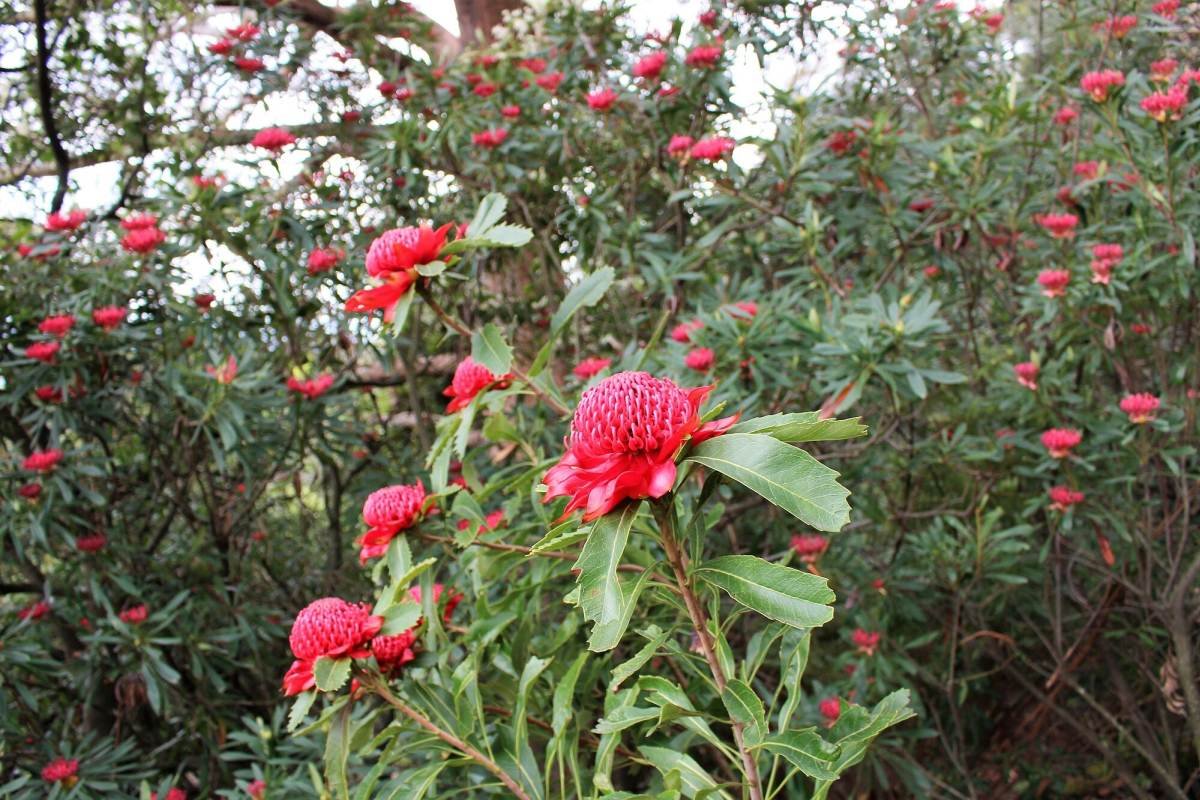
Spring is the peak. The waratahs are extraordinary — Sydney's floral emblem blooming on a mountain plateau, with valley views behind them. The proteas are also at their best, and the overall effect is of a garden genuinely thriving in its climate rather than fighting it.
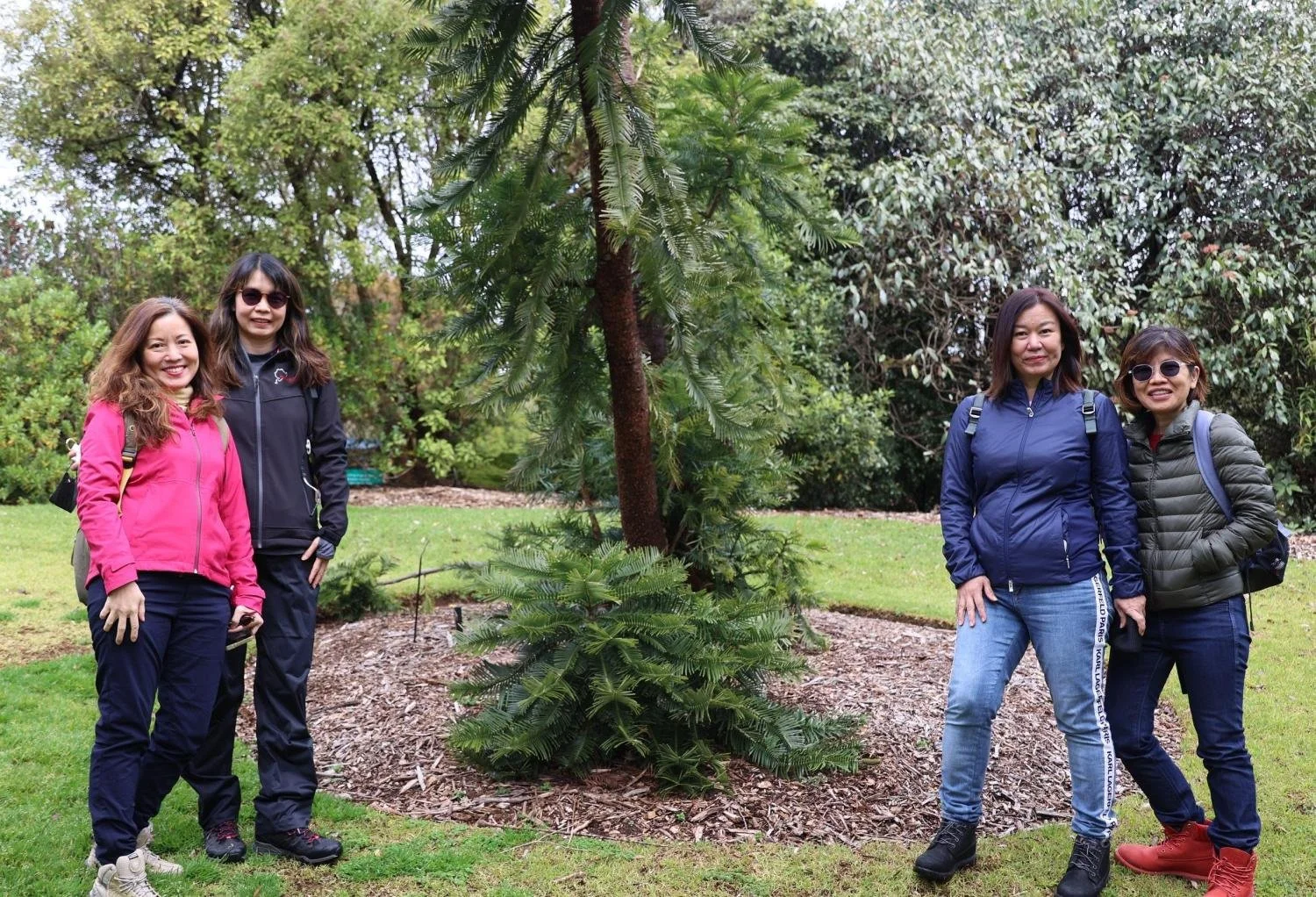
Mt Tomah also holds one of the finest collections of mature Wollemi pines in Australia. This is not coincidental — the Wollemi pine was discovered in 1994 in the Wollemi National Park, which begins just north of here. Finding specimens this size, in a garden this close to where they were discovered, gives them a different weight than seeing them in a pot at a nursery.
High quality year-round; Spring is the reason to time a visit around it.
Mt Wilson and Windyridge Garden
Further west along the range sits the village of Mt Wilson, which exists in a state of considered quietness. The houses are old, the lanes are narrow, and the gardens are serious.
Windyridge Garden, tended by Wai and Rodger Davidson, is one of the finest private gardens in the Blue Mountains — trees, shrubs, ponds, waterfalls, and sculpture spread across a property that takes real commitment to maintain. It has the calm that comes from decades of patient work, and visiting it feels like a genuine discovery.
When We Take This Route
The Bells Line of Road isn't on every Blue Mountains itinerary — it depends on the season, your interests, and how you want to spend the day. Spring is the obvious time, when Mt Tomah is at its best. But the road and its lookouts are worth it in any month, particularly for guests who want more walking and fewer crowds.
If you're interested in coming this way, mention it when you get in touch and Greg will shape the day accordingly.

Protea perfection
majestic

wave after wave of waratahs came at us