Posts in sydney city coast
Sydney Beaches & Bluebottles

In recent weeks beaches around Sydney have been inundated with bluebottles. You will see them either on the sand or in the water.

So what is a bluebottle.

A good place to start in defining a blue bottle is to say what it is not. Although related the bluebottle is not a jellyfish. It is known as a siphonophore.

The most common bluebottle found in the waters around Sydney is Physalia utriculus.

The discussion becomes more interesting when you realise that the bluebottle is not one animal but a grouping of four different colonies of polyps. The word collective comes to mind.

The colonies rely on each other to survive.

One of the colonies is the gas filled sac that floats on the surface of the water. You may see a grouping of bluebottles on the sand as they are often left stranded on the beach waiting for the tide to rise and take them back into the ocean.

The three other colonies in the arrangement are ones for catching prey by stinging it, one for digesting the prey and of course one for the continuation of the species, reproduction.

The bluebottle does not mate but instead reproduces asexually.

Bluebottles are carnivorous feeding on larval fish, small crustaceans and molluscs (snails and clams).

These creatures come to their earthly end when the bluebottle zaps them with venom located in the long tentacles that trail the sac, resulting in the creature being paralysed. The prey is then drawn to the mouth of the bluebottle by the tentacles and consumed.

In Spring and Summer strong winds are responsible for bringing bluebottles to Australian shores. In the other months of the year they exist offshore.

The bluebottles that appear in Australia are sometimes called Pacific Man o’ War. They are less venomous than the Portuguese Man o’ War which is found in the Atlantic.

The name Portuguese man o’ war originates from the resemblance of this siphonophore to 18th-century Portuguese warships when those warships were at full sail.

There you have it a floating warship that can declare war on you whilst swimming or surfing at the beach.

50 shades of blue

just lying around

stranded but not disbanded

waiting for the tide

a floating armada

Sculptures by the Sea 2024 - Eastern Suburbs & Beaches Tour

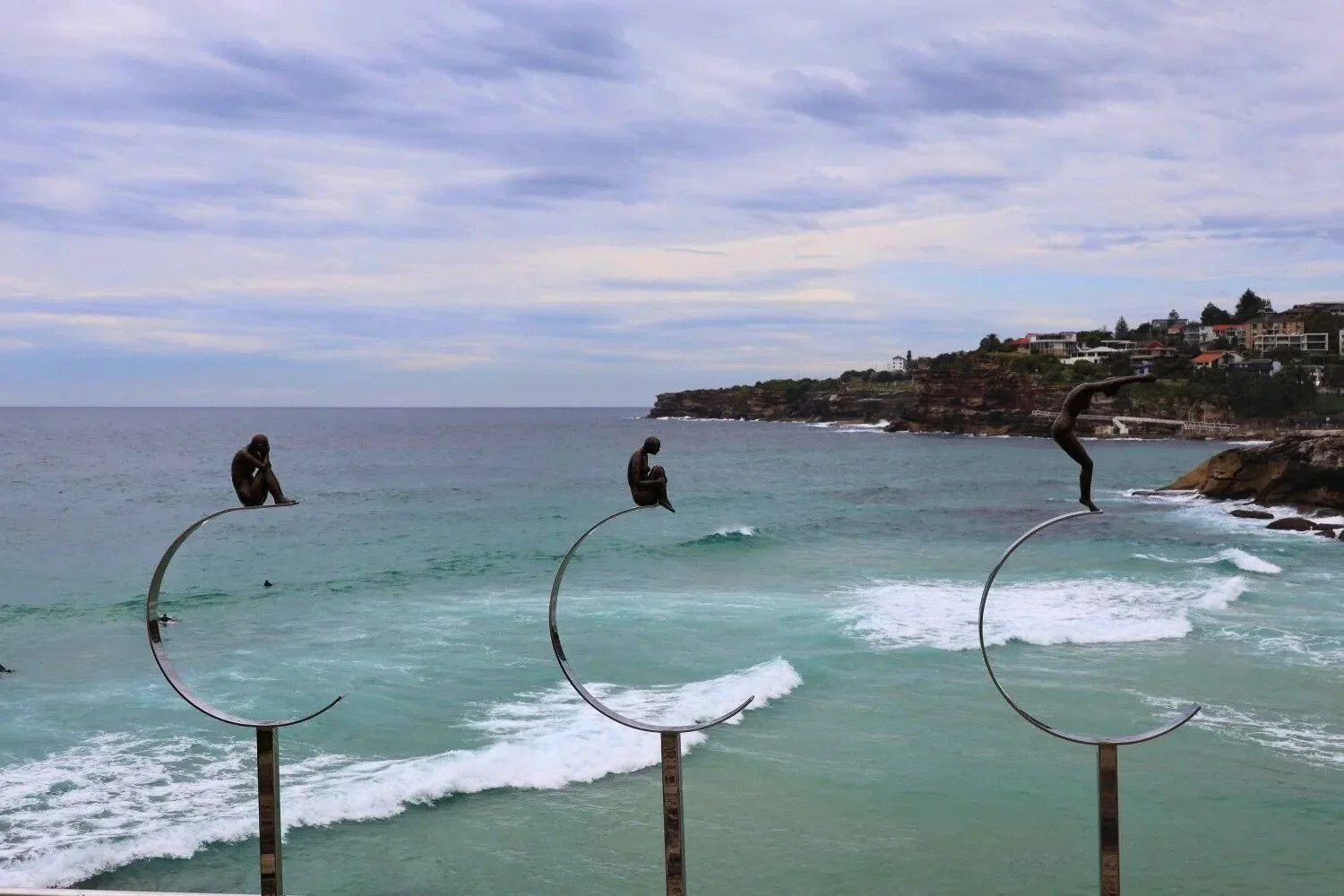
Scultpures by the Sea 2024 is through its first week and comes bearing a payload of exceptional works. 100 artists from 16 different countries have their work on display.

The sculptures stretch from the coastal track near the Icebergs club at South Bondi through to Tamarama Beach.

Two of the sculptures on the sand of Tamarama beach have the unexpected theme of skin cancer. One is made of black fabric which changes shape to resemble a cancer and three pieces of toast draw further attention to the risks of sun exposure.

Another sculpture that will appeal to beach lovers is a shark emerging from a peeled banana skin. The shark appears to be a great white with a wide-open mouth. You can’t help but have a second look.

An amazing contrast! Banana gives birth to shark?

Local surfers with any anxiety towards sea life that bites are advised to ignore this one.  Nothing like seeing a shark to raise confidence as you head out to the surf.

A white spaceman by the artist known as Malarky is perched on the cliff above Tamarama Beach. The statement behind the work is that our species failure to care for the earth makes it destined to return to nomadity.

King Kong makes an appearance courtesy of the artist Denis Defrancesco.

This large reclining fellow was a crowd favourite with his golden balls providing an irresistible photo opportunity. One spectator put her dog just near the two lumps and took photos from all angles!

That’s gold!

Moving onto another metal, stainless steel, a rocket ship has captured one of the most sort after positions on the sculptures circuit. It is just over 8 metres tall.

The second last photo is of a sculpture comprised of granite and rock created by Professor Shen Lieyi. In a highly competitive field this work was judged the winner of the Aqualand Sculpture Award of $100 000.

Sculptures by the Sea is a fine outing and the entry price is zero. Try to avoid the weekend if possible or get there early or late.

On the walk back to our chariot we had the pleasure of passing a wonderful art deco house painted in sky blue. Last photo below - congratulations to the owners.

dont bring this beast back from the beach

sun bakers beware, not much fun being toast

get this banana off me

Big boots to fill

King Kong meets local mut

stainless and ready to rocket

winner of the big bucks, work titled, Tracing

art deco beauty

Sydney's new surf break

URBNSURF

Last week Sydney Nimble visited the premises of URBNSURF’S wavegarden at Sydney Olympic Park.

The same company has been running a wavegarden in Melbourne for several years (2020).

The visit was timed to observe one of the more advanced sessions (Advanced turns). May as well see the place at a more challenging level.

Just check the bookings page to select a session you like. It can be as easy or hard as you wish - Cruiser, Progressive Turns, Intermediate, Advanced Turns, Advanced and Expert.

And the verdict – looks pretty cool. Next step is to dig into the pocket, dust off the board and head out there myself!

An option to book either lefts or rights is available as two distinct waves are generated in different areas at the same time. There is a barrier separating the area where you catch either wave (see third photo - set up).

It’s not a long wave but what you get is quality and the quantity of waves is spectacular, around 15 per surfer in one hour. Tell me of a beach where you will get that many waves in 60 minutes.

And we observed surfers queuing in a relaxed harmonious order!

No snaking or disappointment in missing out on waves due crowded breaks, or having to paddle through pounding beach breaks.

The surfers we watched were catching the waves with ease, just one miss – should have paddled a little harder. One or two came off but most were having no trouble with riding the waves.

The water temperature was around 18 celsius. It can get cold in winter (as low as 12 celsius) whilst in summer my guide, Luke, advised me that the water temperature can get to a very pleasant 25 celsius.

All the necessary gear can be hired, board, wetsuit, etc, or bring your own.

The hire option is handy for learners, someone wanting to try a different size or type of board and surfers visiting from other regions or countries who don’t have their equipment with them.

At the end of the session you can hang out and have a burrito and or beer, and video footage from your session is screened for one hour.

Go forth and check out a unique place in Sydney’s west, with surf!

Update (27/9)

Sydney Nimble has just added URBNSURF as a place that can be visited on our bespoke tour.

It could also be added to the itinerary of any of our other tours, such as an inclusion on the way to the Blue Mountains.

skilled young surfer - see the change in the next photo

working the body to maximise cut back

set up

space to chill

boards, boards and more boards

take off zone

off to the races

nice one

radical manouvre in the background!

Three Petals: Highlights of Barangaroo

ONE BARANGAROO

Pecking order

One Barangaroo is Sydney’s tallest skyscraper (275 metres).

The Sydney Eye Tower is in fact greater in height (310 metres) but is not a skyscraper.

Although One Barangaroo is Sydney’s largest skyscaper it is only the 4th tallest skyscaper in Australia. The largest is located on the Gold Coast, and positions 2 & 3 are held by buildings in Melbourne.

What’s in it

One Barangaroo is a 75 level mixed use venue containing a luxury resort with 349 hotel rooms and suites, 76 luxury residential apartments, retail shops, cafes, restaurants, bars and a casino.

Design concept

One Barangaroo was designed by a firm of Brittish architects, WilkinsonEyre, after winning an international design competition in 2013.

The brief was for a building that would create a landmark design of high quality, which would reflect Sydney’s vibrancy, relationship with water and its role as an international city.

Wilkinson Eyre’s design narrative is based on the concept of three petals. Two petals twist towards the sky whilst the third petal peeled off to the side and provides the bulk of the hotel accommodation.

When I look at One Barangaroo the concept of petals does not really hit me.

If the different sections are comparable to petals they are indeed very long petals. It is only after looking at early sketches that the idea begins to make more sense.

Features

What I do like about the building is as much as what it is not as what it is. It is not your standard rectangular skyscraper and the architect has gone to great lengths to avoid right angles.

Instead there are many turns, twists and curves.

If you walk around the building from street level it is not an easy shape to take in or describe.

One Barangaroo is an imposing building and by not being capable of simple definition it keeps you observing and guessing.

The provision of many discrete balconies for the apartments and the fact that the building narrows as it reaches its peak are both attractive features.

Who doesn’t like balcony access to fresh air in a high rise apartment.

When you look up from ground level it is noticeable that the balconies are aligned to compliment the buildings spiraling curves.

By narrowing the building as it approaches its pinnacle One Barangaroo does not overwhelm the surrounding environment.

The progressive drop in height of the completed next door buildings (One Sydney Harbour and International Towers) works well when you see One Barangaroo in the setting of other buildings in Barangaroo South.

This feature is particularly noticeable from a vehicle driving south on the Sydney Harbour Bridge. The buildings drop in a relatively sequential line to the east.

If you look at the building from the north west side the shape of the podium resembles the bow of a ship, (see photograph 5 below ).

The external glass provides for different reflections throughout the day depending upon the time and weather.

It can certainly sparkle in the afternoon when you look at it from the west as you drive into the city.

A visit to One Barangaroo is one of many places that are available to visit on Sydney Nimble’s Custom itinerary tour.


under construction 2019

a sleek finished product - other nearby buildings include One Sydney Harbour, International Towers and Barangaroo House

looking up from the front

sculpture in front of the hotel foyer

the bow of a boat?

the building sits above an expansive four level podium

curves, turns and twists

One Barangaroo in the distance with the soon to open Barangaroo metro station in the foreground

North Head Manly lookouts and scenic walk

North Head

Hanging swamp, Memorial walk, Fairfax walk and Third Quarantine cemetery

After nearly two weeks of rain it was time to revisit the hanging swamp at North Head. The last time Sydney Nimble was there in early January the swamp did not exist. Bone dry!

Well the swamp is back with plenty of water.

A hanging swamp occurs when water soaks through sandstone and then hits harder to penetrate rock such as claystone or shale. The water percolates back up creating moist peaty soils which support swamp heath plants.

Close to the hanging swamp is Memorial Walk, a paved track that links 5 memorials dedicated to conflicts which have involved Australia, whether that be war or recent peacekeeping.

During WWII the whole of North Head was a significant defence base and one of the most fortified places in Australia.

The memorials have an oblong shape with information on raised plaques and have been tastefully built with sandstone.

After Memorial Walk we continued our walk east to another track, Fairfax walk, which has been re-opened after a major upgrade in 2023.

This walk provides access to two well designed lookouts, Burragula and Yiningma lookouts. Burragula is an indigenous word for ‘sunset’ and Yiningma means ‘cliff edge’.

We finished where we started (car park behind the café) and this loop takes around 60-75 minutes to complete.

A small detour to the Third Quarantine cemetery was made before getting into the car.

It is only a short walk from the car park and has many graves of Australians who died from diseases we no longer think too much about: smallpox, bubonic plague and scarlet fever.

What swamp? (January 2024)

Bone dry

A recovery story (May 2024)

time to reflect

one of 5 war memorials that can be accessed from Memorial Walk

9.2 inch coastal gun

visitors from afar

Third quarantine cemetery at North Head

Pier 2/3 Walsh Bay Sydney

Background

Pier 2/3 is one of several historic wharves located at Walsh Bay.

They were built in the early 20th century (circa 1913-1920) and named after the chief engineer of the Sydney Harbour Trust and designer of the wharves, Henry Walsh.

The wharves had a number of uses including the storage and export of wool, distribution of general cargo and goods and docking of cruise-liners.

However by the 1980s the Walsh Bay wharves were locked up, no longer fit for purpose.

Wharf 4/5 was renovated in the mid 1980s and became the home of the Sydney Theatre Company and other dance and choir organisations.

Pier 2/3 had to wait a lot longer and was not fully renovated until late 2021. The pier opened to the public in March 2022.

Wharves 4/5 and 2/3 now make up what is known as the Walsh Bay Arts Precinct.

Brief comments on a few features

The vision for Pier 2/3 included the creation of rehearsal rooms, performance spaces and offices for the Australian Theatre for Young People, Australian Chamber Orchestra and Bell Shakespeare, plus 1800 square metres of event and commercial space.

The changes were required to maintain the heritage character of the wharf.

In interviews architect, Peter Tonkin, referred to the separate venues as boxes, in view of the need to ensure soundproofing of each venue.

Some of the new walls built within the wharf to accommodate these separate venues have had their impact reduced by floor to ceiling mirrors.

The idea was to make the walls disappear and the mirrors have the added benefit of making the entrance area appear larger.  

To access the venues take the stairs or lift. Upon reaching the next level you will encounter a good sized area dedicated to socialising before and after a performance, with a bar available for refreshments. An essential!

It is a pleasure to walk on timber floors and see chunky hardwood support posts and exposed timber beams, which are used as a feature in various locations. Look above the stairs as you walk down to the entrance area.

Ceiling heights have been subtly raised in different areas of the pier to accommodate lighting, sound and services equipment.

Outside features

The west facing side of Pier 2/3 has four separate fire stairs. It is a timber building!

Three of the four staircases lead to a viewing platform, which has been described as a contemporary interpretation of a gantry. Grand harbour views are available from the platforms.

If you look up as you approach the entrance way to Pier 2/3 from the east facing side you may observe a wharf artefact on display, being part of a hydraulic hoist or ram.

Muscular mooring bollards have been retained on the wharf particularly near the water edge but make sure you don’t kick one as they are heavy duty.

Youth theatre

The Australian Theatre for Young People has been named the Rebel Theatre in recognition of the extraordinary generosity of actor, Rebel Wilson.

Rebel provided a crucial piece of the funding puzzle by donating $1M to the youth theatre from a court case settlement.

A rebel with a cause!

Australian Chamber Orchestra performing area

This is a beautiful room that has attractive timber paneling, groovy entrance doors, a ceiling full of technology (mostly lights) and the ability to adapt to the audience’s size by allowing additional rows of seats to be introduced as required.

Final comments

The refurbishment of Pier 2/3 has created some fantastic new performing arts venues for Sydney.

The painstaking and extensive work undertaken has maintained the industrial ambience of the wharf and it is delightful to see a heritage wharf brought sympathetically back to life.

welcome to Pier 2/3

double crossed at the bathroom

wharf artefact is a part from a hydraulic hoist

stairs, gantry, ocean harvesters and the building is bird friendly (no spikes)

mirror mirage - how long is that corridor?

name in neon

take a seat and enjoy a chamber orchestra

Summer in Sydney's Eastern suburbs

As all tracks and trails in the Royal National Park were closed due to a total fire ban yesterday’s tour of the Royal National Park was replaced by a trip to some of Sydney’s finest beaches.

Exceptionally warm weather in the last few days (5 consecutive days over 29 degrees celsius) has made it feel like we are in the middle of a summer heat wave.

We visited the Eastern Suburbs beaches of Bondi, MacKenzie’s, Tamarama and Bronte and the day included several walks at different beaches, a swim at Bronte baths and lunch at Manly Beach.

The first walk was from North Bondi to MacKenzies Beach where the four legged brigade happily frolicked on the beach.

Tamarama was not open to swimmers but did provide nice conditions for board riders with smooth shapely waves.

Bronte’s most popular spot was the baths, which had the whitewater from waves occasionally breaking into it.

The water temperature was on the cold side but became reasonable if you swam around for a while.

By the time we reached Manly in the early afternoon the wind had kicked in robbing the northern beaches of shapely waves - just mush.

A few beach pictures from yesterday and one of a mural at Bondi Beach.

Bondi promenade

MacKenzies Beach may be tiny but the dogs dont mind

a splendid sight

and another

rights

Bronte baths

too easy

Sydney’s Northern Beaches - dolphins, big swell at Avalon rockpool, a Sydney red gum at West Head

Sydney’s Northern Beaches - dolphins, big swell at Avalon rockpool, a Sydney red gum at West Head, Ku-ring-gai National Park

Two days ago Sydney Nimble was treated to the sight of a pod of dolphins playfully swimming and surfing waves at the northern end of Palm Beach.

They were spotted whilst walking near Barrenjoey Lighthouse. There were at least 14 dolphins in the grouping. A rare treat!

On the way back from Palm Beach the swell had picked up during the day. A few individuals had chanced their arm and bodies by swimming in the Avalon rockpool which was being bombed with foam from breaking waves. The brave swimmer(s) in two of the photos are clearly exposed to the power of ocean.

Next stop was West Head lookout where we came across a Sydney red gum (Angophora Costata) which was shedding it rich earthy-coloured bark.

The smooth barked Sydney red gum is a native of the east coast of Australia and is characterised by twisted and gnarly branches.

Summer is a great time to visit and enjoy the beauty of the Northern Beaches and Ku-ring-gai Chase National Park!

dolphin line up

90 Years Strong - The Sydney Harbour Bridge

Ninety years ago today (19/3/1932) the Sydney Harbour Bridge was officially opened.

Celebrations were organised to celebrate this milestone, which included light shows, a concert at Campbells Cove and vintage ferries and trains running during the day.

Historic double decker buses took passengers over the bridge from North Sydney to Wynyard and return for a number of hours.

Bridge climbers received a discount of $90. Strangely there were a lot of climbers on the bridge today!

The Sydney Harbour Bridge is one of those imposing structures that you never get sick of looking at when commuting across it.

It is too large and imposing to ever be ignored.

Happy birthday, Sydney Harbour Bridge.

What name should we give this bridge?

Why do they all have to sit upstairs?

grey sky, grey steel

And so they climbed, no not because of the discount, but because it’s there.

Sydney Opera House

The Sydney Opera House is located on a prominent point on Sydney Harbour and is a stone’s throw (maybe two) from the Sydney Harbour Bridge.

In 1957 Danish architect, Jorn Utzon, was chosen as the opera house architect from a field of over 200 contestants.

His design sketches were bold and inspiring. It was clear that the proposed building was going to be exceptional.

As with many ambitious plans reality kicked in and numerous modifications of the design were necessary.

This design process was pain staking and it was not until 1963 that the design was finalized.

The greatest challenge concerned the shape of the opera house’s most distinctive feature, large curved vaulted shells.

The shape had to have both structural integrity and the ability to be economically built.

Many shapes were tried ranging from parabolas to circular ribs to ellipsoids.

Ultimately the shape of the opera house’s shells was based on the dissection of a top of a sphere into segments.

One of the many interesting features of the opera house is that the shell walls curve and blend into the roof, joining at a central point.

Jorn Utzon did not want a flat roof and his desire for the opera house to be seen from all sides was satisfied by constructing the shells on an elevated platform (podium).

Due to the massive size of the shells the design had to allow for in situ construction, resulting in the shells being built piece by piece from precast concrete.

The final design chosen for the opera house is in the author’s opinion a significant enhancement of the original drawings, providing for a more upright and striking building, whilst still retaining the look of the original sketches.

Postscript

Whilst taking the photos for this blog Sydney Nimble came across the Sydney Opera Company’s principal soprano, Julie Lea Goodwin, who will be performing in the upcoming production of La Boheme at the Sydney Opera House.

Julie’s hair, make-up and art deco dress/ gown/ jewellery were exquisite. Nice to meet an opera singer at the opera house!

geometric shapes create an outstanding sculptural design

early afternoon light highlights zig zag patterns

art deco charm

the podium’s elevation vastly improves the display

Julie Lea Goodwin

Sydney landmark - El Alamein Fountain, Kings Cross

A popular stop on our custom and eastern suburbs tours is the El Alamein Fountain in Kings Cross.

You may wonder why a fountain at Kings Cross brings on a discussion of World War II. The simple answer is that the El Alamein fountain commemorates two battles fought in World War II near the Egyptian town of El Alamein. More than 1200 Australian infantrymen lost their lives in the El Alamein battles which stopped the Axis forces (German and Italian armies) from taking over Northern Africa. It was a major turning point in the war. Winston Churchill described the siginificance of the El Alamein battles in the following way:

Before Alamein we never had a victory. After Alamein we never had a defeat.

The El Alamein Fountain was designed by Robert Woodward, who worked as an armourer in WW II.

The design of the fountain was inspired by the shape of a dandelion and the frame is comprised of 211 radially dispersed stalks. The stalks shoot out water which creates a bubbly or saucer like film. Wind conditions and direct sunlight will change the look of what you see. Water from the fountain overflows into several layered pools. It is a masterful modernist fountain and highly eye catching should you be walking or driving by. A wonderful mist is created when the fountain is firing. The construction of the El Alamein Fountain was completed in 1961.

Happy 60th birthday El Alamein Fountain!

pigeon paradise

inspiration

under the bonnet

mist monster

Sculpture by the Sea - walk Bondi to Tamarama

Annual event Sculpture by the Sea is a popular stop on several of our Sydney private tours. For three weeks from mid-October, the iconic coastal walk from Bondi to Tamarama Beach transforms into a 2-kilometer long sculpture park - the world’s largest free public sculpture event - showcasing over 100 creations by Australian and international artists.

Sculpture by the Sea 2021 can be included in a Sydney Nimble Tours Custom Tour or it can form part of our full day tour of the Eastern Suburbs of Sydney.

Here are a few of our favourite images from past Sculptures by the Sea

Sydney custom itinerary - Chau Chak Wing Museum at the University of Sydney

The Chau Chak Wing Museum is a newly constructed building located at the University of Sydney and incorporates the university’s Art Collection, the Nicholson Museum collection and the Macleay Museum collection into one centralised location.

The building has a nice feel to it with plenty of natural light, soaring ceilings and an easy to understand layout.

Pleasant views of the area to the east of the building have been accommodated by the see through layout which includes large glass walls at the rear of the museum.

The collection in the museum can only be described as eclectic ranging from indigenous art to ancient Roman sculptures, Egyptian mummies, photographs and oil paintings. The variety of items on display reflects the range of artworks that have been donated to Sydney University over the decades.

A visit to the Chau Chak Wing Museum complements a visit to the University of Sydney’s wonderful historic building, the Quadrangle, which is a couple of hundred metres away across the lawn.

We recommend visiting both buidlings.

Entry to the museum is free and the museum is open 7 days a week. Check the website for times, as the weekend opening times are more restricted.

The Chau Chak Wing Museum is one of many options that can be included in a Sydney Nimble Tours bespoke tour.

walk this way

Coffee with your Roman?

see through design

pure style

Sydney custom itinerary - Gothic revival architecture Bronte House

We are happy to create a custom itinerary in any of our tours including highlights of Australian architectural history. Bronte House was built between 1843-1845 and the style of the building has been described as ‘Australian Gothic revival’. It is located a few hundred metres from Bronte Beach (a beach south of Bondi Beach).

Bronte House has some lush gardens which blend into the Bronte gully rainforest.  You could well be somewhere on the north coast of NSW.

Bronte House is only open on one or two weekends each year. From time to time the Waverley Council website posts the details of future opening dates.

The first picture is a view of Bronte House from the backyard followed by an image of a Moreton Bay fig as you look towards Bronte gully.

Moreton Bay figs are a native tree of Eastern Australian and have seriously large root systems. Definitely not a plant for the average backyard!

Bronte House from behind www.paullovelace.photography

Moreton Bay fig

Sydney Harbour Bridge

Perception is often everything in determining how we feel about things. The Sydney Harbour Bridge (SHB) is a structure that can be perceived in many ways. What do you see when you look at the SHB?

From one perspective the SHB is a large steel bridge that allows for the efficient transport of commuters. It provides a crucial transport corridor connecting the north shore of Sydney to the city and several expressways.

Alternatively the SHB can be evaluated from an engineering perspective.

The construction of the SHB began in 1924 and finished in 1932. It was built during a period when computer assisted design and manufacture did not exist. The bridge was built from both ends so that the arch was complete when the two halves of the bridge met in the middle.

Would the two halves align when it was time for them to be joined and how would a steel bridge of this scale deal with expansion and contraction in varying weather conditions. Would the bridge be strong enough to take the large daily load of passenger vehicles and trains.

From an identity viewpoint the SHB is one of Australia’s most well known and popular symbols. It was a brilliant achievement for a young nation and the 100th year anniversary of the commencement of construction is only four years away.

That achievement came at a price. Sixteen workers lost their lives during construction and it took over 50 years to pay off the cost of building the bridge (1988).

Aesthetics as opposed to any functionality was behind the decision to build two massive granite covered pylons at each end of the SHB arch. The four pylons are 89 metres in height and the light grey colour of the granite complements the bluey grey colour of the arch.

The pylons project strength and provide symmetry when the bridge is observed from the distance.

The SHB offers ongoing activities, although a lot of people would not see it in this way.

You can simply drive across it and enjoy the view, walk or cycle across it, climb it, visit the Sydney Harbour Pylon or see it sparkle on News Year Eve when it is used for spectacular fireworks displays.

One final perspective on the bridge is captured in the words of John Bradfield (chief engineer of SHB) who described it as ‘the blue arch of Heaven’.

view from Lavender Bay

pylon power

Sydney Art Deco Architecture

Art Deco is a style that was adopted in both the exterior and interior of buildings, light fittings, carpets, ceramics, clocks, furniture, machines, household appliances, cars, ocean liners, jewellery, ornaments and posters in the period between the two world wars.

Art deco is unashamedly flamboyant and reflects the larger than life mentality of the 1920s.

The term Art Deco evolved in the 1960s from a shortening of two words, ‘Arts Decoratifs’, as used in the title of a 1925 design exhibition held in France: “Exposition Internationale des Arts Decoratifs et Industriels Modernes”.

Some of the characteristics and features of Art Deco designs include: geometric shapes in the form of triangles, trapezoids, zigzags; chevron patterns; straight lines and sweeping curves, layered shapes and symmetry; vibrant colors; stepped forms and modern materials.

Art deco buildings may include elaborate panels and ornate carvings.

Sydney has rich vein of Art Deco architecture both in the city and surrounding suburbs. If you look for it you will find Art Deco commercial buildings, apartments, cinemas, hotels, shops and lift foyers.

We recently visited a few of our favourite Sydney Art Deco buildings.

The towers in the entrance to Luna Park (last photo) have classic Art Deco features including vertical and horizontal straight lines, trapezoids, vibrant colours and scalloping in the upper part of the tower.

If you would like to visit some of Sydney’s best art deco buildings let us know and we can design a half day tour or adjust another tour to include an hour or two visiting these buildings.


The Metro Theatre (formerly Minerva Theatre) has striking vertical and horizontal lines and gracious curves.

Black marble adorns the entrance to the CML Building. The business chamber inside, which is occupied by a restaurant, is exquisite.

The lobby of the Primus Hotel (formerly MWSDB Building) is grand, with amazing height, glass ceiling and scagliola clad columns.

Geometric shapes galore

the entrance to Sydney’s palace of fun (Luna Park)

Cape Solander surfing Sydney

It is late May 2020 in Sydney and the seas have been up due to a low pressure system off the coast of New South Wales.

There are a few places in Sydney that surfers seek out when large swells arrive.

One of these places is Cape Solander, which is located just south of the entrance to Botany Bay in the Kamay Botany Bay National Park.

Cape Solander was named after the Swedish naturalist, Daniel Solander, who visited Australia on the Endeavour in 1770.

Cape Solander is a hair raising break that is suited to surfers who are highly skilled, courageous and fit.

A give away for a large wave is the spray you can see at the top of the wave (first photo).

The waves at Cape Solander only start to perform when a reasonable swell is around, otherwise there is nothing to catch.

The boogie board rider in the photos was not being toed in whilst the stand up surfer at a nearby cliff break to the south (see last photo) was assisted by a jet ski.

If the seas are up and you want to experience the raw power of the sea Cape Solander is hard to beat.

You may also be treated to some spectacular surfing.

Sydney Nimble Tours can include a visit to Cape Solander in one of our days out.

take off

solid wave size

end of the line

grassy knoll views, city in background

another powerful break

Northern Beaches Tour Spectacular Sydney Harbour lookout - Georges Heights

Sydney Nimble Tours visits Georges Heights on our Northern Beaches, Sydney Harbour, National Park tour.

This area has spectacular harbour vistas that include the entrance to Sydney Harbour, Watsons Bay, Rosebay and Shark Island. A good view of the city of Sydney is on offer if you look south west.

The harbour aspect also provided a solid location to install defensive artillery should Sydney Harbour come under attack.

Military memorabilia in the form of gun pits, fortifications, canons and anti-aircraft guns have been well maintained and are on display at Georges Heights.

A former military hospital which was built for patients from World War I houses the anti-aircraft gun.

Close to the gun pits is the Gunner’s Barracks, a fortified sandstone building built in the 1870s. This building was constructed to accommodate artillerymen whose job was to look after the artillery and if necessary fire it.

In the course of a recent visit to Georges Heights we came across a chilled kookaburra resting on a sign near the Barracks.

Our feathered friend was most accommodating and happily posed for photographs.

The kookaburra is a member of the Kingfisher family and has one of the most unusual bird calls.

The laughing Kookaburra is not laughing at another kookaburra’s jokes! The cackle of the Kookaburra is a territorial call aimed at warning other birds to stay away.

Be gone, the insects, lizards, rodents and small snakes in this patch are mine!

The word kookaburra is yet another example of an indigenous word enriching our language and originates from the Wiradjuri word “guuguuburra”.

a delightful Australian bird

boom

loud and proud

Eastern suburbs or custom itinerary tours - Waverley Cemetary

Waverley Cemetery is one of those places that is overlooked by visitors to Sydney but well worth a stop - the coastal views are spectacular!

The coastal walk way from Bondi to Coogee runs just below the eastern edge of the cemetery. A walk along this impressive scenic pathway offers the chance to make a detour into the cemetery.

The second reason we find it appealing relates to the history and attitudes that are captured in a cemetery. Many of Sydney’s well known people have been buried here and Waverley cemetery contains an expansive collection of death memorabilia, including sculptures, graves, vaults, mausoleums and memorials.

The cemetery opened in 1877 and an intact drinking trough for horses remains on the pavement near the cemetary entrance. There is a vast quantity of stonemasonry on display including sculptures of angels, neo classical symbols and tombstones.

The cemetery is well laid out and designed with many internal roads and retaining walls. Fatigued cortege members may choose to rest in a number of sandstone shelters interspersed throughout the grounds.

The stand out monument in Waverley Cemetery is the Martyr’s Monument which is dedicated to the 1798 uprising against British rule in Ireland. The remains of one of the leaders of the rebellion, Michael O’Dwyer and his wife, reside here.

The memorial includes a large Celtic cross and also commemorates the Easter Rising of 1916 and the Long Kesh Hunger Strikes in 1981.

It is estimated that around 100 000 people have taken up digs at the cemetery, ranging from poets (Henry Kendall and Henry Lawson) to well known business people, politicians and sporting stars.

A Sydney tour of Waverley Cemetery is easily accommodated in our Sydney Bespoke Tour. Get in touch and we can discuss.

Two Irish Wolfhounds guard the entrance to the Irish Memorial

Angelic embrace

something is alive in the cemetary

a graceful sculpture remembering a woman who passed away in 1910

Sydney custom day tour - historic Darlinghurst Gaol

Sydney Nimble recently had the pleasure of going on someone else’s tour. Our guide Tom took us around the National Art School, which was formerly the Darlinghurst Gaol.

The buildings in the National Art School represent one of the most formidable collections of sandstone colonial architecture in Australia.

For those of us who like colonial architecture they are right up there - well preserved and swirling with stories.

The Darlinghurst Gaol specialised in accommodating bushrangers, rapists and murderers. It operated from 1841 until 1914.

76 people were hanged in the Darlinghurst gaol, and Sydney’s most notorious 19th and early 20th century criminals were provided with either short or long term accommodation: Captain Moonlight; Jimmy Governor (aka Jimmy Blacksmith) and the Rennie boys.

Famous Australian poet, Henry Lawson, did some time for failing to pay alimony and child desertion. Henry used the time well writing a number of poems.

The tour focused on the history of the buildings when they were used as a gaol.

D Block housed women prisoners and in one corner of this building plug marks can be seen on the wall where a padded cell was kept for more difficult customers.

D Block was connected to the prison chapel by a walkway as those in charge were uncomfortable with the idea of female prisoners venturing onto the general grounds of the gaol.

Probably a good idea in view of a number of rapists residing in the vicinity.

D Block was used as a theatre and for other events from late 1950s through to the 1970s. Catherine Hepburn and Robert Helpmann visited D Block in 1955 to assist in promoting the theatre whilst it was being restored.

The prison’s chapel has a cupola, which is a small structure placed on the dome or roof of a building. Cupola’s are used to provide light and or ventilation. Two photographs below show the chapel’s cupola from inside as you look up from the floor and from the exterior.

The sandstone for the prison walls was cut and hewn by convicts working in a chain gang at nearby quarries. Each sandstone block was marked so that a tally could be kept and the first photo below shows these markings.

The sixth photo shows D Block, which was comprised of three levels when the gaol operated. If you look behind the projector the markings can be seen where the stairs used to be located.

We highly recommend Tom’s tour, which can be booked through the National Art School’s website.

The Darlinghurst Gaol was a cruel place and tormented those persons that were incarcerated here.

Nevertheless stories about the prisoners, jail conditions, executions, and the public’s reactions to the gaol are fascinating.

markings identified the prisoner who worked on the sandstone block

chapel and cupola topped with a weather vane

the dark side of the cupola

not a metaphor - real ball and chain

dreaded D Block