Spring Tours in the Royal National Park

Spring Tours in the Royal National Park

We are now half way through Spring in the Royal National Park and visitors have been rewarded with some wonderful native flowers.

It is at this time of year that ordinarily non descript plants come alive with exceptional flowers. Until this point of time you may not be that interested in identifying a plant. A striking flower changes everything.

The Gymea Lily, a native to Sydney and surrounds can be counted on to perform. Its bright red flowers are on display all over the park. If you miss seeing this plant you are not looking very hard!

Whilst on the colour red some wonderful waratahs may be spotted by carefully scrutinising the bush whilst driving through the park. We noticed some fine examples on the road to the parking area for figure 8 pools.

The Sydney Boronia (Showy Boronia) was blooming in patches whilst the thin and thick leaved drumsticks could be seen on the side of the road.

Many plants in the Royal National Park belong to the Fabaceae family and some of these are stunning.

The handsome bush-pea was seen extensively on the road between Flat Rock Creek to Wattamolla. A bright and colourful yellow flower with a dash of red.

The parrot-pea has an intense yellow flower and was frequently spotted.

These two plants are legumes and take nitrogen from the air and convert it with the help of bacteria into ammonia. This occurs in nodules in the plants root system. When the plant dies and decomposes the soil is enriched by nitrogen that is returned to the soil.

The Golden Wattle, Australia’s floral emblem, is also a legume.

Grass trees (Xanthorrhoea) are flowering in the park and you may observe flower spikes that have a yellow colouring. The yellow or golden colour is created by pollen attaching to the small flowers on the spike.

Further into the rainforest area of the park the yellow flower of the cabbage tree was on display.

Gymea Lily flower

A Waratah, the NSW floral emblem

A sea of showy Boronia

Pultenaea stipularis, known as Fine-leaf Bush-pea or Handsome Bush-pea

Dillwynia Floribunda, otherwise known as a parrot-pea

swamp honey myrtle

thin leafed drumstick

so many fantastic colours

grass tree flower spike coated in yellow pollen

yellow flower of the cabbage tree palm

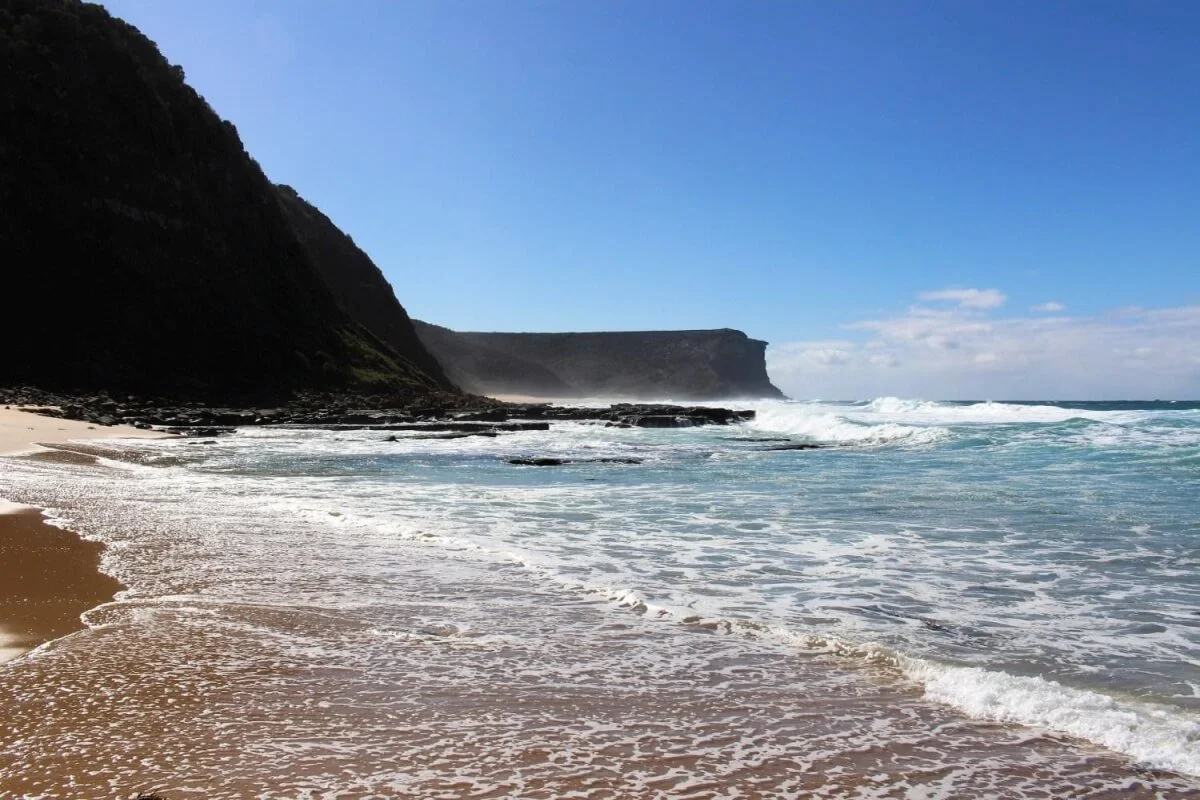
Beautiful Garie Beach at the Royal National Park

Garie Beach re-opens today

Whilst undertaking a Royal National Park tour today Sydney Nimble dropped by the road barrier preventing access to Garie Beach.

We were delighted to be informed that the barrier would be removed in the next few hours and to come back after lunch.

Upon returning the barrier was gone and we headed down to Garie Beach. It has been a long time between visits.

The road to Garie Beach was closed in 2022 due to floodwaters causing a section of the road to collapse.

Whilst driving to the beach we noticed the major area of repair which involved moving a section of the road into the hill and driving over 100 15-metre long concrete piles into the side of road for a distance exceeding 150 metres.

That’s a lot of support!

Upon arriving at the beach and walking south from the car park it was noticed that some new sandstone stairs had been built and the former track above the rocks on the beach is no longer in use.

In fact it doesn’t exist!

If you are hiking south along the Royal Coastal Track, which runs from Bundeena to Otford, just take the stairs near the Garie Surf Life Saving Club and ascend.

A photo of the new stairs is shown below.

I was advised by Royal National Park staff that a lookout has also been constructed on the new walkway.

Things are happening in the Royal National Park!

And being the opening day there were no fisher people or surfers. That won’t last long!

new road

love those supports

Where are the surfers, beach walkers and fisher people?

new stairs

just in case you forget

path and track gone - go back to the stairs

nice to see that headland again

Hanging Rock - Spectacular Sightseeing in the Blue Mountains

Hanging Rock

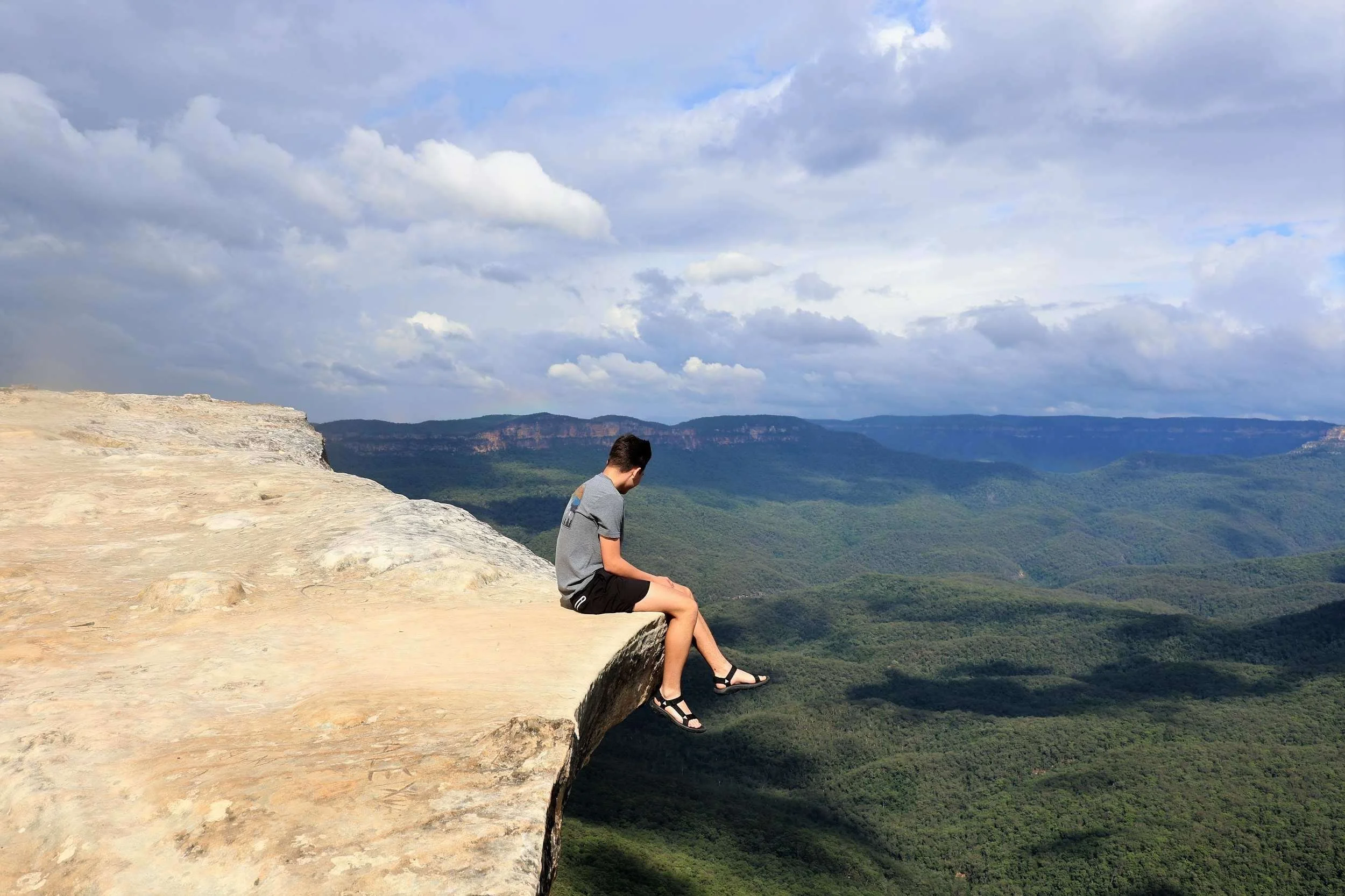
Hanging Rock is a block of rock located in the Grose Valley of the Blue Mountains National Park.

Is a large sandstone formation that appears to hang off the side of a cliff.

Getting to it

If you are driving from Sydney go past Blackheath and hang a right off the Great Western Highway onto Ridgewell Rd.

Once on Ridgewell Rd it is only a short drive to the Hanging Rock car park.

Alternatively put your mountain bike on the train from Sydney and cycle from Blackheath Station.

If you are walking from the car park a solid trek along a fire trail awaits you. It took our group around 2hrs 30 minutes to do the return walk (10kms).

At the end of your trek or bike ride you will make your way upwards via a track and stairs to Baltzer lookout.

Allow maybe 20-30 minutes or more to suck up the moment at Hanging Rock and Balzter Lookout, so a reasonable time allocation is 3 hours.

Enjoy the view!

From the Baltzer lookout you will see Hanging Rock and the steep walk down takes only a few minutes.

And remember you are only few metres from a dramatic unfenced drop to the valley below.

Arrival

Once nearing Hanging Rock you will have sandstone walls on either side as you look at the distant Grose Valley and a nearby cliff face (see 2nd photograph).

When you are close to the rock its detachment is apparent as a three feet jump is required to reach it.

The rock itself is at an angle (maybe 60 to 80 degrees) to the cliff face and as a consequence it protrudes into the Grose Valley.

The protrusion is greatest at the top of the rock as hanging rock tapers in as you look down it.

How was it created

Two books on the Blue Mountains have identified* the event which brought about Hanging Rock, namely a landslide in the late 1930s.

The landslide is likely to have been preceded by a long period of weathering and erosion of joints in the sandstone plateau and underlying claystone. When claystone is no longer strong enough to support the sandstone above a collapse occurs.

Its all about the photo

Whilst at Hanging Rock several visitors hopped onto the rock and made their way to the end point of the rock.

At the pointy end of Hanging Rock is a rock that is one metre or more in length that has broken away from the rock before it.

Another little feature to add to the edginess of a photo!

Just watching the ‘no fear brigade’ is suspenseful in itself as the drop from Hanging Rock to the Grose Valley can only be described as formidable, at least 120 plus metres (maybe more).

I would not want to be on that rock on a windy day!

We enjoyed our visit to Hanging Rock but only consider it if you are comfortable with heights.

*page 153 of The Blue Mountains, Exploring landscapes shaped by the underlying rocks, uplift and erosion, Peter Hatherly & Ian Brown; page 708 Blue Mountains Geographical Encyclopaedia, Brian Fox, Michael Keats OAM and John Fox, Released: February 2018, Updated: July 2023

Bald Hill is the area of low bush on the area located on the opposite cliff, with Mount Banks in the distance

Looking between Hanging rock on the left and the rock supporting Baltzer lookout on the right

Up close - on the top of Hanging Rock is a rock that has broken away from the rock before it

the gap between hanging rock and the cliff reduces in size as you look downward

not a place to have a picnic

another look at the gap that exists between hanging rock and the cliff

if only my mother could see me now!

Further down from Hanging Rock is yet another rock that visitors may be drawn to

The Imperial Hotel Clifton - a favourite tour stop

So Imperial

Background

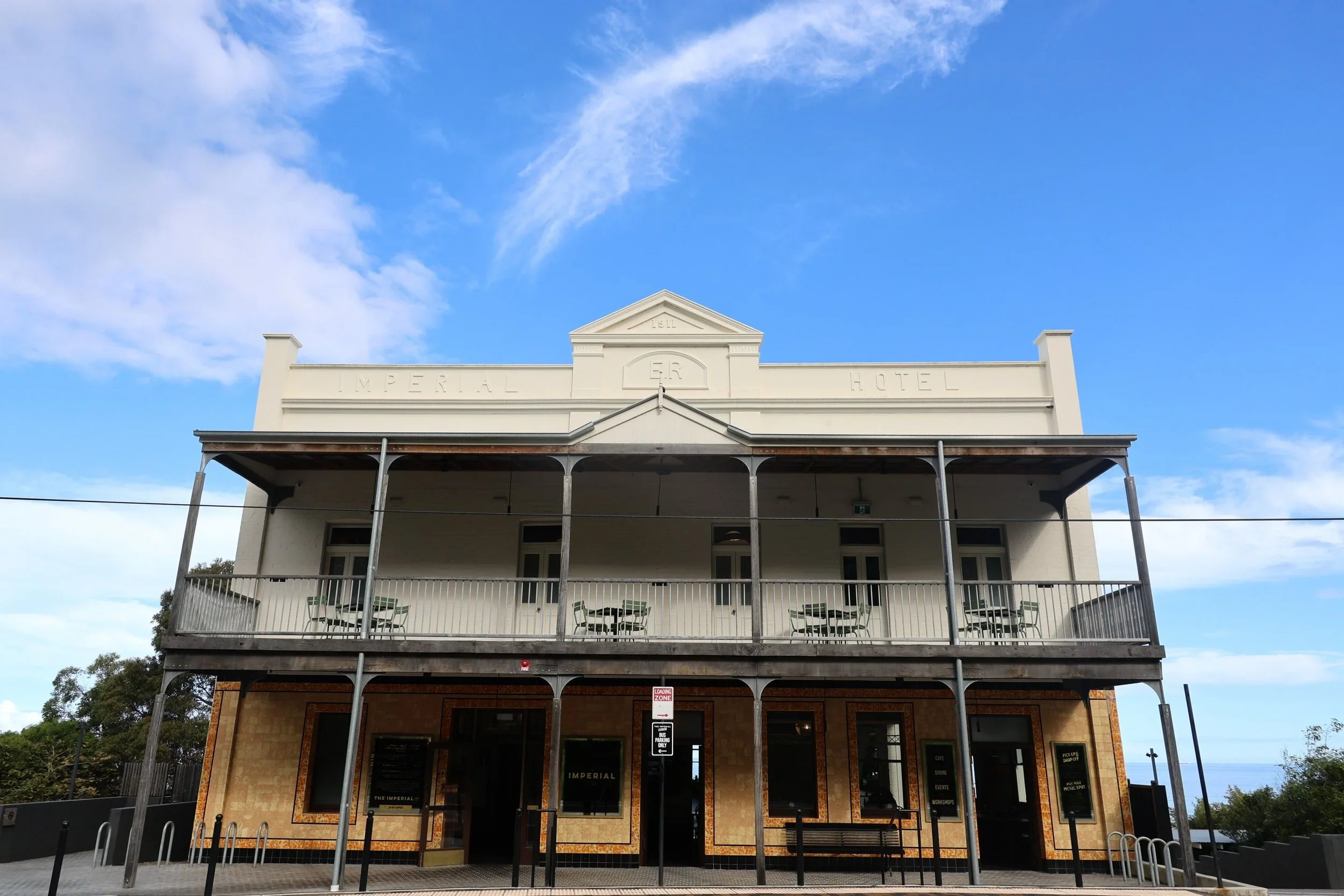
The Imperial Clifton is a hotel located on the coast south of Sydney. It is only a few hundred metres from Sea Cliff Bridge.

Originally the site was occupied by a small timber framed pub built for local miners in 1884.

After being bought by the Resch’s Brewery it was demolished and replaced by the existing building in 1911.

Lets move forward 80 years to the closure of the local coal mine in 1991. Not a good outcome for a nearby pub!

Things went from bad to worse when the main road on which The Imperial is located closed in 2003 due to persistent rockfalls, particularly after rain.

And guess what, the Imperial Clifton also closed in 2003.                

The building was boarded up and fell into a state of disrepair until 2015 when a local club, the Shellharbour Workers Club, bought the pub.

The white knight comes riding to the rescue!

Renovation and extension

Due to vandalism and general decay a renovation of substance was required and the rear of the building was extended.

The renovation and extension have been sympathetically done to maintain and blend with the heritage features of the hotel.

When you drive towards the hotel from the south it is hard not to be impressed by the building’s grand stature.

The Imperial Clifton re-opened for business in 2020.

What’s in there

The Imperial Clifton does not offer any accommodation.

The bottom level (basement) can be accessed from the car park and is used for utilities (fireplace wood storage, bathroom, staff area).

Before entering the basement level from the car park consider having a look at the splendid views of the ocean from the small beer garden at the rear of the hotel.

The next level (ground level) is at street level due to the block sloping downwards towards the ocean.

To reach this level take the stairs or catch a lift up from the basement and observe historical newspaper articles covering the lift walls.

Alternatively ascend via the stairs and see a hand painted wall mural based on a 1961 photo of former staff and licensee of the hotel.

The ground floor has a public bar at the front, several small rooms, a large restaurant area facing the ocean, a commercial kitchen and a long bar on the south side of the building.

There are many features inside the Imperial that warrant mention:

- Some of the interior brick walls have had mortar removed leaving exposed brick which gives the interior a rustic feel;

- Large light fittings sourced from lighthouses greet visitors in the main foyer;

- First class joinery is evident throughout particularly if you look at the door and window frames and flooring;

- Several original fireplaces have been restored and a wood fire is lit in colder months;

- The mottled cream and orange wall tiles in the front bar have been matched with the original tiles;

- The dark timber floor throughout the hotel is reclaimed timber hardwood oiled with hardwax, creating an authentic feel for an early 1900s building;

- The front verandah has been rebuilt to look like the original balcony at the time the hotel was built;

- Two large gold leafed mirrors are placed either side of the front door, with one of the mirrors containing a short history;

- The internal walls have before and after renovation photos of the building whilst a television runs in the public bar outlining the building’s transformation.

The top level (level 1) of The Imperial is reserved for larger gatherings (weddings, events and corporate activities) and is similar in design and layout to the ground floor.

The Parlour

Across the hall from the front bar is a room known as The Parlour. It is a reminder of what was the norm in past decades.

Women in Australia were not allowed to drink with men in the public bars of hotels until the 1970s.

The Parlour or Ladies Lounge was a room where women at The Imperial Clifton could partake of alcoholic drinks prior to the relaxation of these laws.

The Parlour did not have its own bar but provided drinks to women through a server with a special hatch!

Our view

A great deal of thought and effort went into renovating and modernizing this building whilst maintaining its heritage features.

The Imperial Clifton is a lovely building and the high ceilings, views from rear, airiness and the adaptive reuse of materials is a pleasure to see and enjoy.

Indulge yourself in a cappuccino or piccolo, a cold beverage or a meal whilst admiring the pizzazz of a cleverly re-birthed historic building.

forceful frontage

looking through the public bar

public bar

south and east sides of the hotel

you know where your going

thank you lighthouse

an imperial expresso machine

front doors and gold leafed mirrors

rustic signage near the basement doorway entrance

happy staff

can’t beat a genuine smile!

font that works

Nimble Travels to Sri Lanka - Arugam Bay

Intro

Sydney Nimble Tours encourages employees to travel overseas as it helps improve our perspective of traveling and touring generally. It is interesting being taken on a tour as opposed to providing one!

This year’s annual trip was to Arugam Bay and surrounds, located on the South East Coast of Sri Lanka.

It takes between six to seven hours to drive to Arugam Bay from the main entry point to Sri Lanka, Colombo.

Surfing

Arugam Bay becomes a surfing mecca when the swells arrive from May to September.

We stayed in this area for 12 days in early June and found the main break lived up to all the hype being a classic fast peeling right with several sections. The downside is that everyone else knows this and it is an intensively competitive environment for catching a wave.

There are plenty of other breaks in the area including Lighthouse Beach, Peanuts, Elephant Rock, Pottuvil and Panama Beach.

The two breaks we liked the most were Elephant rock (on a large swell day) and Peanuts outer break as opposed to the break near the beach. Bare in mind Peanuts is exposed to the wind and best ridden when the swell is a reasonable size.

Panama Street

Panama Street is the main road into and out of Arugam Bay. The shopping strip located on this road, just behind the beach, is a concoction of restaurants, bars, clothes shops, board shops, ice cream outlets, small general stores and coffee shops.

It is a vibrant strip with varied food offerings and travelers from all over the world can be seen enjoying them.

The road itself has plenty of activity with tuk tuks, push bikes, motor bikes, cars and even the odd cow making their way along it.

For non-surfers a few days at Arugam Bay is probably sufficient, whilst surfers can easily spend a week or two weeks in this area.

Kumana National Park

The other activity we enjoyed was driving in a jeep around the Kumana National Park which is an hours drive from Arugan Bay.

Kumana is easily booked with a number of shops offering tours. It is described as an eco tourism attraction and bird sanctuary.

The park has a broad range of animals and we had the good luck of coming across a leopard only a handful of metres from our vehicle.

The leopard didn’t stay long but it was still a thrill to encounter a large cat!

The bird life in Kumana which includes wetlands areas was plentiful and highly interesting.

Some of the more outstanding feathered friends that we encountered included: Malabar Pied Hornbill, Crested Serpent Eagle, Painted Stork, Little Green Bee Eater and the Red Wattled Lapwing.

The Malabar Pied Hornbill is an exotic bird with a most unusual beak, whilst the Crested Serpent Eagle was spotted low on the trunk of a tree waiting for a chance to greet and eat new and interesting local snakes.

Crocodiles, elephants, lace monitors, mongoose, water buffalo, were all spotted throughout the day although the sloth bear did not appear. We were advised that the bear is more likely to be seen in the morning.

Environment

The weather we experienced whilst in Arugam Bay in June can only be described as intensely hot from mid morning to late afternoon. June is one of the hottest driest months whilst the area gets most of its rain from October to February.

Arugam Bay along with the areas further south have a desert feel and heat to match with a lot of sand dunes and sandy soil.

The ocean water is amazingly warm (late 20’s celcius) and after surfing in the morning you come out of the water with a solid thirst.

We had a refreshing and fun stay in Arugam Bay and recommend it be included as part of any trip to Sri Lanka in the dry season.

Favourite restaurants: Dosa Station, Gecko, Hopper Man, Bambini’s Café, Wayside Thai and the Bay Vista Hotel restaurant for tasty pasta and a delicious ginger lime cheesecake.

Favourite coffee shop: Kaffi

Best decision: using Deyo Tours to get around; we spent 16 days with Chaminda whose service and commitment exceeded all expectations

Best clothing: Slow days shop and the caravan T shirt at the Squeeze Me cafe

Let downs: Sri Lanka needs a wider range of beers!


Arugam Bay beach and surfing break at the point

Lighthouse Beach is 25kms north of Arugam Bay

this break is just to the left of the lighthouse

Lighthouse Beach in the afternoon

Elephant rock beach

Elephant Rock needs a reasonable swell to work

Arugam Bay beach scene is a few hundred metres west of main break

loads of learners, around the corner from main break

surf schools have proliferated at many of the breaks - Peanuts surf break

Peanuts hero

to zero

long line up, main break

Morning time at the main break

Leopard, Kumana National Park

joyful soul, Kumana National Park

Malabar Pied Hornbill, Kumana National Park

Crested Serpent Eagle, Kumana National Park

Painted Stork, Kumana National Park

Spotted Deer, Kumana National park

Amazing Sea Cliff Bridge - Sydney South Coast Tours

Background

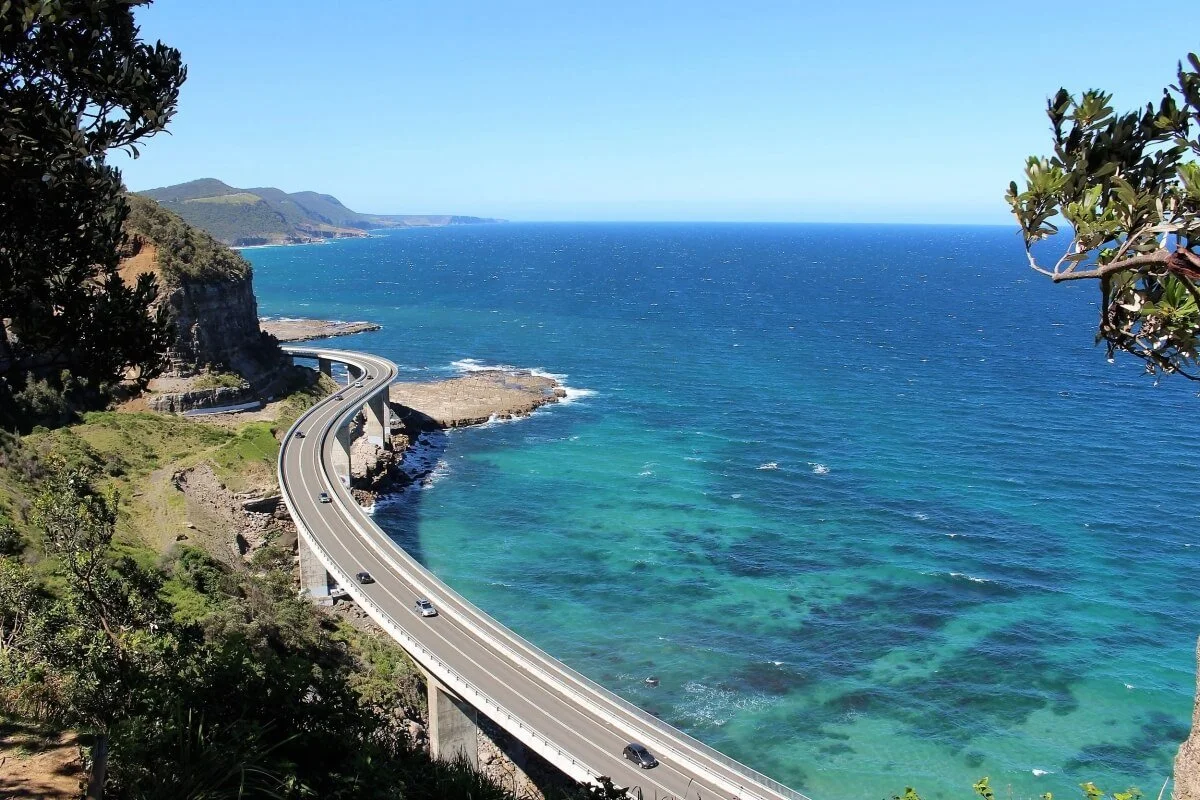
Sea Cliff Bridge is located on the coast of New South Wales, south of Sydney, between the small coastal towns of Coalcliff and Clifton.

It forms part of Lawrence Hargrave Drive, a road that extends from Helensburgh to Thirroul, which was named in 1926 after inventor, aeronautical pioneer and explorer, Lawrence Hargrave.

Longstanding rock fall problems had been experienced on Lawrence Hargrave Rd between Coalcliff and Clifton due to the road at that time being positioned right next to the cliff and in 2002 the problem became acute resulting in the road being permanently closed.

The rock debris was dropping from the steep cliff hovering above the cliff hugging road, particularly after rain.

A bridge that would be located some distance from the cliff was seen to be the answer to the problem of rockfalls.

Although the NSW Government initially had some reservations about building a bridge to replace the existing road in view of the cost, environmental concerns and geotechnical issues, it was decided to go ahead.

Construction began at the start of 2004 and the bridge was completed in December 2005.

Some parts of the former road can still be seen if you visit Sea Cliff Bridge particularly at the south end.

A rusted cream guard rail shows where the road was located. Part of the underpinning sandstone wall supporting the old road has collapsed and bushes have overgrown other parts of the former road.

New bridge(s)

Two bridges were in fact necessary to remedy the situation. Sea Cliff Bridge is up to 70 metres from the cliff in places and provides for plenty of room should a rockslide from the cliff eventuate.

It is easy to miss the first bridge, Lawrence Hargrave Bridge, as you drive south past Coalcliff. In fact you may not even think you are driving on a bridge, but rather a new piece of road.

Lawrence Hargrave Bridge measures 210 metres and was incrementally launched.

Incrementally launched bridges are built in segments in a casting bed. The segment is pushed out of the casting bed across the obstacle to be crossed. The casting bed may then be used to make another segment.

The bridge is made from one side only. They are commonly used where there are access problems or to minimize disruption at ground level and the spans generally do not exceed 60 metres.

The second bridge, Sea Cliff Bridge, is a balanced cantilevered bridge and 450 metres long.

This type of bridge is more suitable for longer spans and will typically consists of two cantilever arms that extend in opposite directions from a single support.

Why visit

The design, engineering and aesthetics of Sea Cliff Bridge are what make it so attractive.

When you first see it in the distance you are drawn to have a second look at a roadway suspended above the ocean that curves with the contours of the surrounding cliffs.

The curves and flow of the bridge gracefully fit in with the rugged surrounding environment. Both bridges, Lawrence Hargrave and Sea Cliff Bridge were built in difficult environments.

The challenging environment consisted of sea on one side, steep cliffs on the other, underlying coal seams and very little available land.

The construction of both bridges in such a situation is a fine engineering achievement.

If you visit don’t just drive over the bridge, park just beyond where the bridge finishes in the south, and take a walk.

It is a pleasure to walk along the bridge and enjoy the views of the ocean, the nearby dramatic cliff and the several large rock platforms that can be seen below.

Put this one on your list!

Be Imperial

And if your in the mood for a little more try The Imperial at Clifton for a coffee, cold drink or something to eat. This hotel has been sympathetically renovated maintaining its historical features, has lots of natural light and broad ocean views.

It is only a few hundred metres down the road heading south. 


a wonderful bridge for a car commercial

view of the hovering bridge and Illawarra Escarpment from Bald Hill

a different perspective from the rock platform

green headed monster and mate

nobody understands me

the evil cliff and broken guard rail of former road

looking north

like insects to light motor cyclists are drawn to the bridge

The Imperial at Clifton

Sydney Beaches & Bluebottles

In recent weeks beaches around Sydney have been inundated with bluebottles. You will see them either on the sand or in the water.

So what is a bluebottle.

A good place to start in defining a blue bottle is to say what it is not. Although related the bluebottle is not a jellyfish. It is known as a siphonophore.

The most common bluebottle found in the waters around Sydney is Physalia utriculus.

The discussion becomes more interesting when you realise that the bluebottle is not one animal but a grouping of four different colonies of polyps. The word collective comes to mind.

The colonies rely on each other to survive.

One of the colonies is the gas filled sac that floats on the surface of the water. You may see a grouping of bluebottles on the sand as they are often left stranded on the beach waiting for the tide to rise and take them back into the ocean.

The three other colonies in the arrangement are ones for catching prey by stinging it, one for digesting the prey and of course one for the continuation of the species, reproduction.

The bluebottle does not mate but instead reproduces asexually.

Bluebottles are carnivorous feeding on larval fish, small crustaceans and molluscs (snails and clams).

These creatures come to their earthly end when the bluebottle zaps them with venom located in the long tentacles that trail the sac, resulting in the creature being paralysed. The prey is then drawn to the mouth of the bluebottle by the tentacles and consumed.

In Spring and Summer strong winds are responsible for bringing bluebottles to Australian shores. In the other months of the year they exist offshore.

The bluebottles that appear in Australia are sometimes called Pacific Man o’ War. They are less venomous than the Portuguese Man o’ War which is found in the Atlantic.

The name Portuguese man o’ war originates from the resemblance of this siphonophore to 18th-century Portuguese warships when those warships were at full sail.

There you have it a floating warship that can declare war on you whilst swimming or surfing at the beach.

50 shades of blue

just lying around

stranded but not disbanded

waiting for the tide

a floating armada

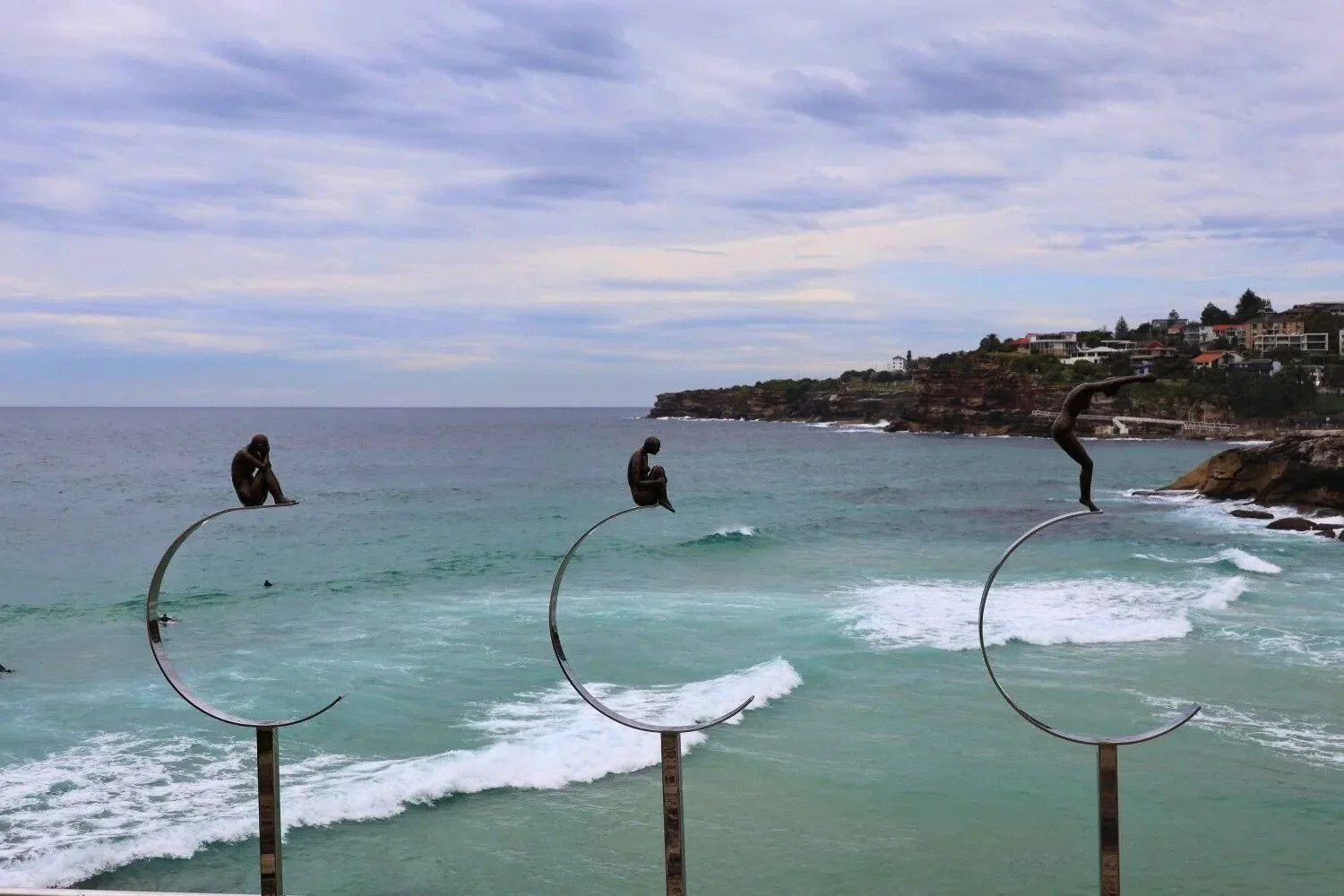
Sculptures by the Sea 2024 - Eastern Suburbs & Beaches Tour

Scultpures by the Sea 2024 is through its first week and comes bearing a payload of exceptional works. 100 artists from 16 different countries have their work on display.

The sculptures stretch from the coastal track near the Icebergs club at South Bondi through to Tamarama Beach.

Two of the sculptures on the sand of Tamarama beach have the unexpected theme of skin cancer. One is made of black fabric which changes shape to resemble a cancer and three pieces of toast draw further attention to the risks of sun exposure.

Another sculpture that will appeal to beach lovers is a shark emerging from a peeled banana skin. The shark appears to be a great white with a wide-open mouth. You can’t help but have a second look.

An amazing contrast! Banana gives birth to shark?

Local surfers with any anxiety towards sea life that bites are advised to ignore this one.  Nothing like seeing a shark to raise confidence as you head out to the surf.

A white spaceman by the artist known as Malarky is perched on the cliff above Tamarama Beach. The statement behind the work is that our species failure to care for the earth makes it destined to return to nomadity.

King Kong makes an appearance courtesy of the artist Denis Defrancesco.

This large reclining fellow was a crowd favourite with his golden balls providing an irresistible photo opportunity. One spectator put her dog just near the two lumps and took photos from all angles!

That’s gold!

Moving onto another metal, stainless steel, a rocket ship has captured one of the most sort after positions on the sculptures circuit. It is just over 8 metres tall.

The second last photo is of a sculpture comprised of granite and rock created by Professor Shen Lieyi. In a highly competitive field this work was judged the winner of the Aqualand Sculpture Award of $100 000.

Sculptures by the Sea is a fine outing and the entry price is zero. Try to avoid the weekend if possible or get there early or late.

On the walk back to our chariot we had the pleasure of passing a wonderful art deco house painted in sky blue. Last photo below - congratulations to the owners.

dont bring this beast back from the beach

sun bakers beware, not much fun being toast

get this banana off me

Big boots to fill

King Kong meets local mut

stainless and ready to rocket

winner of the big bucks, work titled, Tracing

art deco beauty

A unique wallaby at Symbio

Sydney Nimble had its first encounter yesterday with a wallaby joey, Olaf, at Symbio Wildlife Park.

Olaf is an albino and is indeed a rarity, with the chances of being born an albino estimated at 1 in a 100 00. He is the offspring of two proud red-necked wallaby parents!

Olaf was born seven months back but it took a while for zoo staff to recognise his albinism.

No they weren’t sleeping on the job, it just takes a while to pick out albino features as wallabies are on the tiny side at birth, around the size of half of your thumb.

This small joey is named after a character in the Disney film series franchise, Frozen.

We look forward to seeing Olaf becoming a full grown albino wallaby in the months and years ahead.

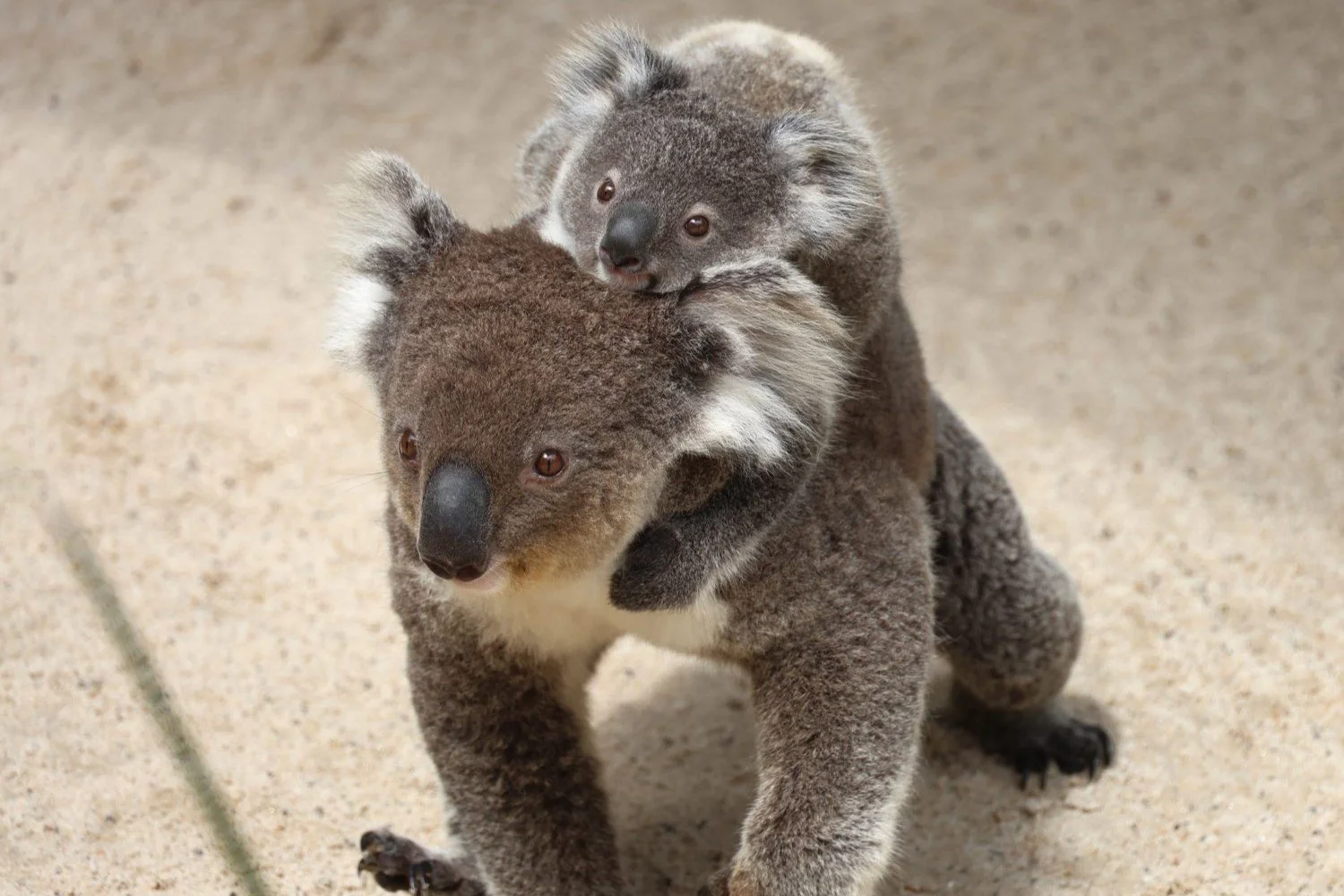
Whilst on the topic of joeys we couldn’t help but take a photo of a koala joey who was happily sleeping just before the 3pm koala exhibition. The arrival of fresh eucalyptus branches did however get the joey alert and moving.

Whilst at Symbio we came across a member of the Honeyeater family, an Eastern Spinebill. Note the long curved beak and warm colours.

These small pretty birds are not easy to photograph and move quickly so it was nice to see one first hand!

A staff member of Symbio made the task of taking a photograph easy as she was holding the Eastern Spinebill in the palm of her hand after the bird collided with a glass window at Symbio.

The bird was stunned and it was anticipated that the small bird would recover after a short period of rest, and fly off.

Fly birdie fly!

We wish the Eastern Spinebill a speedy recovery!

The final photograph from yesterday is of two dingoes who came unusually close to the fence. Its the closest I have been to a dingo!

a media star - announcement by Symbio was picked up local newstations and by several international media outlets

mum and son enjoying a grassy munch

so cute!

audience or no audience, happily dozing

a rare chance to see an Eastern Spinebill up close

another rare event - the dingoes do not generally come this close to the fencing at Symbio

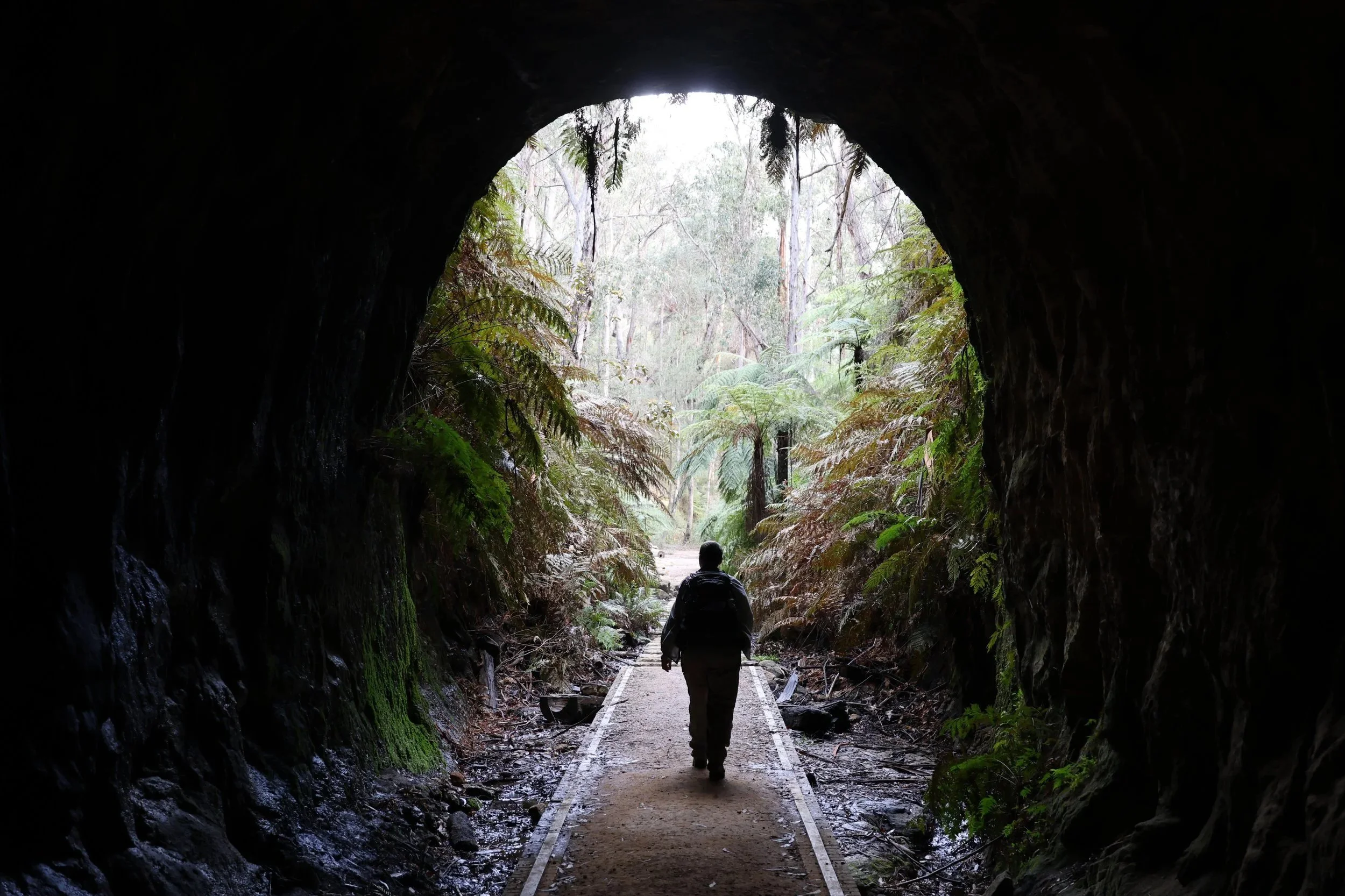
Blue Mountains glow worm tunnel

Glow worms

Glow worms are the larvae of a small fly (fungal gnat). The larvae is bioluminescent, meaning the larvae can naturally produce light from an organ in their body.

The attractive light of the glow worm draws in insects such as midges, mosquitoes and flies for the purpose of capturing those insects in nearby mucus lined silk webs.

Attract, trap and eat!

The blue green glow of the larvae is created through a chemical reaction between an enzyme and chemicals in the larvae and oxygen.

The light is emitted through the transparent skin in the abdomens of the larvae.

The journey

The Blue Mountains glow worm tunnel takes anywhere from 45 minutes to an hour to drive to from Mt Victoria, possibly longer depending upon your vehicle.

The road is bumpy and a four wheel drive will reduce the drive time. If you do the odd pullover to see things allow for up to 1hr 15 minutes.

On the way in you will drive through a one way tunnel – glad there were no cars heading the other way.

Once in the car park it takes around 15-20 minutes to walk to the tunnel entrance.

In the tunnel

We were initially greeted by pitch darkness and little signs of glow worms.

We stopped and waited and as our eyes adjusted we began to see a few small glowing dots.

As the number of people walking through the tunnel dropped off we began to see a lot more glow worms.

Both times I have been to the tunnel the best result has been achieved by quietly standing next to the wall and forgetting about time.

Turn your phone light or torch off and be quiet.

The melodic sound of water created a sense of peacefulness and we enjoyed our time in this strange world of darkness.

After being in the tunnel for around 15-20 minutes we headed back to the car park, glowing!

Returning

We left in the middle of the afternoon and were delighted to see two Australian wood ducks in the grass off the road and wallabies in the bush on three occasions. They took off fairly quickly so sorry no photos – next time.

The glow worm tunnel is definitely worth a visit and provides a nice contrast to many of the other spectacular features of the blue mountains. You will also see some nice stone pagodas on the way in.

pagodas near the glow worm tunnel

more sandstone formations

a one way road has to be navigated near the tunnel car park

leaving the tunnel

Australian wood ducks

thar she glows

Sydney's new surf break

URBNSURF

Last week Sydney Nimble visited the premises of URBNSURF’S wavegarden at Sydney Olympic Park.

The same company has been running a wavegarden in Melbourne for several years (2020).

The visit was timed to observe one of the more advanced sessions (Advanced turns). May as well see the place at a more challenging level.

Just check the bookings page to select a session you like. It can be as easy or hard as you wish - Cruiser, Progressive Turns, Intermediate, Advanced Turns, Advanced and Expert.

And the verdict – looks pretty cool. Next step is to dig into the pocket, dust off the board and head out there myself!

An option to book either lefts or rights is available as two distinct waves are generated in different areas at the same time. There is a barrier separating the area where you catch either wave (see third photo - set up).

It’s not a long wave but what you get is quality and the quantity of waves is spectacular, around 15 per surfer in one hour. Tell me of a beach where you will get that many waves in 60 minutes.

And we observed surfers queuing in a relaxed harmonious order!

No snaking or disappointment in missing out on waves due crowded breaks, or having to paddle through pounding beach breaks.

The surfers we watched were catching the waves with ease, just one miss – should have paddled a little harder. One or two came off but most were having no trouble with riding the waves.

The water temperature was around 18 celsius. It can get cold in winter (as low as 12 celsius) whilst in summer my guide, Luke, advised me that the water temperature can get to a very pleasant 25 celsius.

All the necessary gear can be hired, board, wetsuit, etc, or bring your own.

The hire option is handy for learners, someone wanting to try a different size or type of board and surfers visiting from other regions or countries who don’t have their equipment with them.

At the end of the session you can hang out and have a burrito and or beer, and video footage from your session is screened for one hour.

Go forth and check out a unique place in Sydney’s west, with surf!

Update (27/9)

Sydney Nimble has just added URBNSURF as a place that can be visited on our bespoke tour.

It could also be added to the itinerary of any of our other tours, such as an inclusion on the way to the Blue Mountains.

skilled young surfer - see the change in the next photo

working the body to maximise cut back

set up

space to chill

boards, boards and more boards

take off zone

off to the races

nice one

radical manouvre in the background!

Nimble Travels to Hokkaido

Hiking in Hokkaido

Sydney Nimble encourages employees to travel and share holiday experiences.

On a recent holiday in Hokkaido (Japan’s large northern island) we stopped at an area known for geothermal activity, Lake Akan.

The lake is part of the Akan-Mashu National Park and whilst there why not do a hike!

The selected peak was Mt Meakan and we took the Meakan Onsen Trail. It was described in the national parks pamphlet as taking the shortest time to hike and being slightly more challenging than the other two trails up Mt Meakan.

The trail was classified as a Grade 3 hike. It took us over 5 hours to do the hike whilst the pamphlet estimated time was 4 hours 10 minutes.

For the most part the trail was hard work. The first 40 minutes are through a forest stepping over and around large tree roots and intermittent pockets of bright green moss.

We came across several different and interesting types of fungus ranging from bright red to yellow. Love a new fungus!

After the forest the trail makes its way up the mountain doing its best to avoid many large rocks.

With a great sense of relief we made it to the top of the mountain and started walking on the rim of the main crater.

By that stage the cloud cover was strong and we could see very little in any direction. It is what it is a fellow hiker quipped.

After walking along the rim for about 150 metres and taking a few very average photos in the process, we decided to head back.

No point stumbling around on a creater rim in a white out.

However as luck would have it the cloud cleared in the crater just as we were about to descend. We could now see Mt Meakan’s main crater.

What a sight! Gas was fuming out of several vents and in the distance across the rim a larger plume of gas was whisking into the sky.

The strong smell of sulphur was present with Mt Meakan being one of Japan’s most active volcanoes.

After observing and enjoying the activity in the crater we headed back.

The descent was more difficult than anticipated with volcanic scree being very slippery in spots. Easy to fall, hard to get up!

At last we made it to the bottom. If you ever get around to doing this hike allow five hours for the venture and expect a grade 4 hike by Australian standards.

If you get clear weather the effort is well worth it!


root hopping galore

don’t call me yellow

shiny red fungus

all up from this point

water views

grand design

a sweet view back down from the mountain

white out

close up of crater wall

not an onsen

Mt Meakan main crater

the far side

Three Petals: Highlights of Barangaroo

ONE BARANGAROO

Pecking order

One Barangaroo is Sydney’s tallest skyscraper (275 metres).

The Sydney Eye Tower is in fact greater in height (310 metres) but is not a skyscraper.

Although One Barangaroo is Sydney’s largest skyscaper it is only the 4th tallest skyscaper in Australia. The largest is located on the Gold Coast, and positions 2 & 3 are held by buildings in Melbourne.

What’s in it

One Barangaroo is a 75 level mixed use venue containing a luxury resort with 349 hotel rooms and suites, 76 luxury residential apartments, retail shops, cafes, restaurants, bars and a casino.

Design concept

One Barangaroo was designed by a firm of Brittish architects, WilkinsonEyre, after winning an international design competition in 2013.

The brief was for a building that would create a landmark design of high quality, which would reflect Sydney’s vibrancy, relationship with water and its role as an international city.

Wilkinson Eyre’s design narrative is based on the concept of three petals. Two petals twist towards the sky whilst the third petal peeled off to the side and provides the bulk of the hotel accommodation.

When I look at One Barangaroo the concept of petals does not really hit me.

If the different sections are comparable to petals they are indeed very long petals. It is only after looking at early sketches that the idea begins to make more sense.

Features

What I do like about the building is as much as what it is not as what it is. It is not your standard rectangular skyscraper and the architect has gone to great lengths to avoid right angles.

Instead there are many turns, twists and curves.

If you walk around the building from street level it is not an easy shape to take in or describe.

One Barangaroo is an imposing building and by not being capable of simple definition it keeps you observing and guessing.

The provision of many discrete balconies for the apartments and the fact that the building narrows as it reaches its peak are both attractive features.

Who doesn’t like balcony access to fresh air in a high rise apartment.

When you look up from ground level it is noticeable that the balconies are aligned to compliment the buildings spiraling curves.

By narrowing the building as it approaches its pinnacle One Barangaroo does not overwhelm the surrounding environment.

The progressive drop in height of the completed next door buildings (One Sydney Harbour and International Towers) works well when you see One Barangaroo in the setting of other buildings in Barangaroo South.

This feature is particularly noticeable from a vehicle driving south on the Sydney Harbour Bridge. The buildings drop in a relatively sequential line to the east.

If you look at the building from the north west side the shape of the podium resembles the bow of a ship, (see photograph 5 below ).

The external glass provides for different reflections throughout the day depending upon the time and weather.

It can certainly sparkle in the afternoon when you look at it from the west as you drive into the city.

A visit to One Barangaroo is one of many places that are available to visit on Sydney Nimble’s Custom itinerary tour.


under construction 2019

a sleek finished product - other nearby buildings include One Sydney Harbour, International Towers and Barangaroo House

looking up from the front

sculpture in front of the hotel foyer

the bow of a boat?

the building sits above an expansive four level podium

curves, turns and twists

One Barangaroo in the distance with the soon to open Barangaroo metro station in the foreground

Bombo Quarry Kiama - A Unique Photo Stop

The Bombo Headland Quarry is located north of Blowhole Point at Kiama.

It is an annoying place to get to by car if you are at the blowhole as there is no coastal road to it. A short trip on and off the Princes Highway is required.

The quarry can be accessed by a short walk from either Boneyards Beach or the car park at the north end of Bombo Beach.

Hopefully the wind direction is favourable as you may encounter an experience you wish to avoid - sweet odours emanating from the very nearby Bombo Wastewater Treatment Plant.

Anyway lets move on!

As you walk through Bombo quarry clumps of rock are scattered in a number of areas with the larger clumps closer to the ocean.

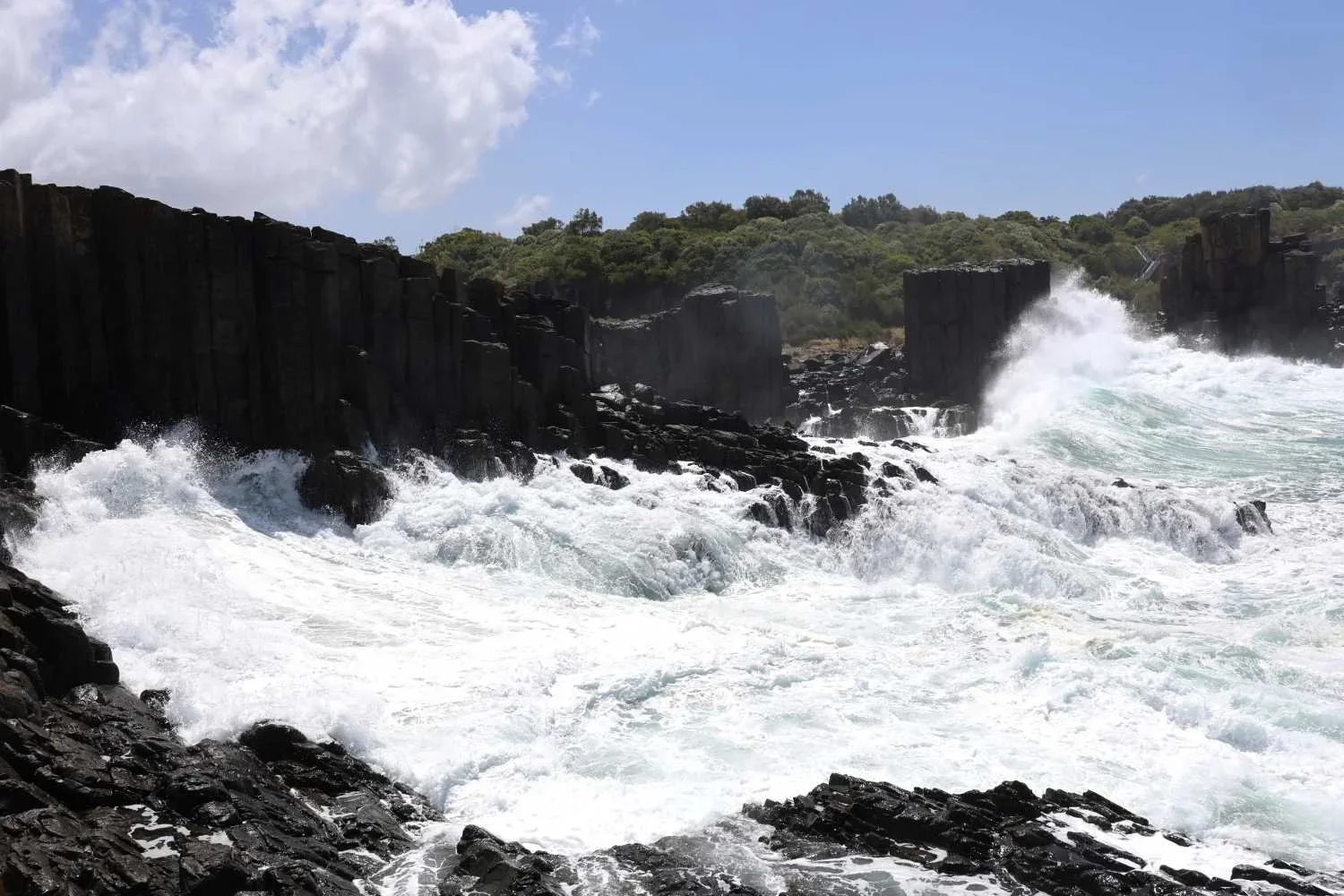
The rocks are hexagonal basalt columns created approximately 270 million years ago when lava cooled, contracted and fractured. It is thought that the hexagon shape is formed in response to stress as the solidified lava cracks.

The unusual name of ‘Bombo’ originated from an aboriginal word of the Wodi Wodi people for thunder. However it was not adopted completely as the indigenous word for thunder was in fact ‘Bumbo’.

A local religious minister was of the opinion that the name was too risque and it was subsequently modified to Bombo.

The Bombo Quarry was mined for its blue metal from 1880 to mid 1920s, and then off and on again (stopped during the depression) until 1944.

It is difficult to ascertain how much quarrying went on at Bombo but the answer is likely to be ‘a lot’. It was the major source of blue metal for the colony and subsequent state of New South Wales.

A significant number of hexagonal basalt columns do however remain.

Walking around the former quarry, which is now a heritage listed, provides access to the tall columns of basalt.

The basalt columns are of varying heights, some as high as five or six metres.

There are a few places where incisions in the rock platform create wonderful opportunities for the waves to form and break with great force.

If the swell is up, the bay in front of the quarry is a cauldron of moving sea water. In large swell conditions it is a sight to be seen.

The basalt columns of the quarry and nearby surging ocean make for an interesting visit, and form part of Sydney Nimble’s South Coast tour.

Who knows you might even spot a bird of prey whilst there.

Eastern Osprey surveying the scene

finely balanced

look behind you!

surging seas

never know what will turn up at Bombo

basalt column holding its ground

Spotting humpbacks Royal National Park Winter Waves

A low in the Tasman Sea sent some large swells to Sydney yesterday.

It was a brilliant day to be on the coast and the energy and power on display was irresistible to watch.

As fate would have it Sydney Nimble was doing a tour in the Royal National Park and further south to Bald Hill, Sea Cliff Bridge and Clifton.

The first photo below is a breaking wave on the reef in the waters off Curracurrang Cove, just south of Wattamolla.

As we headed further south on the Royal Coastal Track some hump back whales were spotted from the cliff (second photo).

Next stop was Curracurrong, home of Eagle Rock.

Normally the sea where Currcurrong waterfall drops into the ocean is reasonably calm and with the sun on it the water can take on a delightful translucent green colour.

See third photo below, solely for comparison purposes (taken a few months back).

Not yesterday however! It was a washing machine of white water (fourth photo).

Further down the coast at Sea Cliff Bridge the ocean was again showing its magic (photos 5-7).

The last two photos are of waves breaking in front of a salt water swimming pool south of Clifton.

Unfortunately we ran out of time to make Sandon Beach. Next big swell!

curling spray pattern coming off a wave crashing onto the rocks off Curracurrang Cove

Hump backs migrating north

gorgeous, but not yesterday (photo from a few months back)

same location, different look

Sea Cliff Bridge - right place to see the waves roll in

rock platform just north of Sea Cliff Bridge

not a day for rock fishing

another smashing wave

left the swimmers at home!

North Head Manly lookouts and scenic walk

North Head

Hanging swamp, Memorial walk, Fairfax walk and Third Quarantine cemetery

After nearly two weeks of rain it was time to revisit the hanging swamp at North Head. The last time Sydney Nimble was there in early January the swamp did not exist. Bone dry!

Well the swamp is back with plenty of water.

A hanging swamp occurs when water soaks through sandstone and then hits harder to penetrate rock such as claystone or shale. The water percolates back up creating moist peaty soils which support swamp heath plants.

Close to the hanging swamp is Memorial Walk, a paved track that links 5 memorials dedicated to conflicts which have involved Australia, whether that be war or recent peacekeeping.

During WWII the whole of North Head was a significant defence base and one of the most fortified places in Australia.

The memorials have an oblong shape with information on raised plaques and have been tastefully built with sandstone.

After Memorial Walk we continued our walk east to another track, Fairfax walk, which has been re-opened after a major upgrade in 2023.

This walk provides access to two well designed lookouts, Burragula and Yiningma lookouts. Burragula is an indigenous word for ‘sunset’ and Yiningma means ‘cliff edge’.

We finished where we started (car park behind the café) and this loop takes around 60-75 minutes to complete.

A small detour to the Third Quarantine cemetery was made before getting into the car.

It is only a short walk from the car park and has many graves of Australians who died from diseases we no longer think too much about: smallpox, bubonic plague and scarlet fever.

What swamp? (January 2024)

Bone dry

A recovery story (May 2024)

time to reflect

one of 5 war memorials that can be accessed from Memorial Walk

9.2 inch coastal gun

visitors from afar

Third quarantine cemetery at North Head

Blue Mountains Zig Zag Railway

A zig and a zag

The Zig Zag Railway provides an entertaining and fun day out.

The action is a trip into the past with a ride on a heritage train hauled by a steam locomotive.

Sydney Nimble took a group of five on the steam train, including a two and half year old.

The atmosphere was cheerful amongst the many passengers as the train moved away from Clarence.

We were rewarded with a unique experience and could not have been more impressed with the staff.

They are all volunteers, doing it for the love.  The men on the train from the driver to the rest of the crew were dressed in authentic overalls (or something close to) from the era, and some with caps!

It just added to the charm. Happy train workers waived us in as we arrived at several stops and when entering the station passengers were greeted by enthusiastic staff who provided old fashioned tickets.

At different stages of the journey we went through tunnels and crossed sandstone viaducts which were built on the back of hard labour in the mid 19th century.

Zig Zag opened in 1869 and operated until 1910.

Well done Zig Zag, we appreciated your efforts and recommend a visit to anyone who wants to do something fun and different.

Choo choo!

Postscript

Availability

Plan this one carefully as the Zig Zag railway only operates for around 6 days a month and the trip takes 90 minutes in total from Clarence.

And yes if you are doing a Blue Mountains Tour with Sydney Nimble Tours on one of these days it can be included!

Name

So why is the railway called Zig Zag?

A zig zag track design using reversible ramps makes a steep gradient more manageable although the train will have to travel a greater distance.


all aboard

dressed to impress

sandstone viaduct

leg stretch

groovy artwork

happy campers

Pier 2/3 Walsh Bay Sydney

Background

Pier 2/3 is one of several historic wharves located at Walsh Bay.

They were built in the early 20th century (circa 1913-1920) and named after the chief engineer of the Sydney Harbour Trust and designer of the wharves, Henry Walsh.

The wharves had a number of uses including the storage and export of wool, distribution of general cargo and goods and docking of cruise-liners.

However by the 1980s the Walsh Bay wharves were locked up, no longer fit for purpose.

Wharf 4/5 was renovated in the mid 1980s and became the home of the Sydney Theatre Company and other dance and choir organisations.

Pier 2/3 had to wait a lot longer and was not fully renovated until late 2021. The pier opened to the public in March 2022.

Wharves 4/5 and 2/3 now make up what is known as the Walsh Bay Arts Precinct.

Brief comments on a few features

The vision for Pier 2/3 included the creation of rehearsal rooms, performance spaces and offices for the Australian Theatre for Young People, Australian Chamber Orchestra and Bell Shakespeare, plus 1800 square metres of event and commercial space.

The changes were required to maintain the heritage character of the wharf.

In interviews architect, Peter Tonkin, referred to the separate venues as boxes, in view of the need to ensure soundproofing of each venue.

Some of the new walls built within the wharf to accommodate these separate venues have had their impact reduced by floor to ceiling mirrors.

The idea was to make the walls disappear and the mirrors have the added benefit of making the entrance area appear larger.  

To access the venues take the stairs or lift. Upon reaching the next level you will encounter a good sized area dedicated to socialising before and after a performance, with a bar available for refreshments. An essential!

It is a pleasure to walk on timber floors and see chunky hardwood support posts and exposed timber beams, which are used as a feature in various locations. Look above the stairs as you walk down to the entrance area.

Ceiling heights have been subtly raised in different areas of the pier to accommodate lighting, sound and services equipment.

Outside features

The west facing side of Pier 2/3 has four separate fire stairs. It is a timber building!

Three of the four staircases lead to a viewing platform, which has been described as a contemporary interpretation of a gantry. Grand harbour views are available from the platforms.

If you look up as you approach the entrance way to Pier 2/3 from the east facing side you may observe a wharf artefact on display, being part of a hydraulic hoist or ram.

Muscular mooring bollards have been retained on the wharf particularly near the water edge but make sure you don’t kick one as they are heavy duty.

Youth theatre

The Australian Theatre for Young People has been named the Rebel Theatre in recognition of the extraordinary generosity of actor, Rebel Wilson.

Rebel provided a crucial piece of the funding puzzle by donating $1M to the youth theatre from a court case settlement.

A rebel with a cause!

Australian Chamber Orchestra performing area

This is a beautiful room that has attractive timber paneling, groovy entrance doors, a ceiling full of technology (mostly lights) and the ability to adapt to the audience’s size by allowing additional rows of seats to be introduced as required.

Final comments

The refurbishment of Pier 2/3 has created some fantastic new performing arts venues for Sydney.

The painstaking and extensive work undertaken has maintained the industrial ambience of the wharf and it is delightful to see a heritage wharf brought sympathetically back to life.

welcome to Pier 2/3

double crossed at the bathroom

wharf artefact is a part from a hydraulic hoist

stairs, gantry, ocean harvesters and the building is bird friendly (no spikes)

mirror mirage - how long is that corridor?

name in neon

take a seat and enjoy a chamber orchestra

Royal National Park - Eagle Rock coastal walk

The coastal walk to Eagle Rock is a spectacular highlight of The Royal National Park

Eagle Rock is a large sandstone overhang in the Royal National Park, south of Sydney. It has the shape of an eagle’s head, with a beak, eyes and mouth on display.

Visitors are greeted with a sign depicting the shape of Eagle Rock when they drive into the Royal National Park from the south (Otford in the south) or from Sydney in the north via Sir Bertram Stevens Drive.

The only way to reach the eagle is by foot and it takes at least an hour and up to an hour and a half to walk to it depending on how often you stop and your walking speed.

And there are no shortcuts back!

Eagle rock can be accessed from the coastal track starting at either Garie Beach (south of the rock) or Wattamolla Beach (north of the rock).

Alternatively walkers can take the Curra Moors firetrail and head overland from Sir Bertram Stevens Drive.

As you approach Eagle Rock from the North you will see a large rectangular protruding block of sandstone.

The top of the rock is relatively flat and the rock looks rectangular in shape.

To see the rock from the south side it is necessary to cross Curracurrong Creek and if you look at it directly from the other side of the bay it is indeed very different.

You will now enjoy the view of an eagle’s head. There is no rectangle.

Weathering and erosion processes have carved out a shape that resembles the head of an eagle although some visitors see a less glamorous turtle’s head. We are going stick with an eagle’s head!

It is quite perplexing that from one angle you see a rectangle whilst from another angle you have the head of an eagle.

The first two photos below show the rock from the north and the third and fourth photos are taken from a southern vantage point.

If you proceed further south (80 metres or so) to the next waterfall which flows from Curra Brook, the rock changes again and it begins to lose its eagle shape.

Whilst on the topic of protruding rocks with facial features another overhanging rock has been identified in the Royal National Park.

The relative (fifth photo) is not as pretty as Eagle Rock but there are some distinct features: a forehead, eye, flattened nose or beak and a mouth.

Grumpy rock?

The final two photos are of a wedge tailed eagle, taken at nearby Symbio Wildlife Park.

Eagle Rock from the north looks to be just a protruding rectangular rock

close up

what a turnaround

celebrating the eagle

Grumpy rock

Wedge tailed eagle at Symbio Wildlife Park

a noble and beautiful bird

The Royal National Park freshwater pools

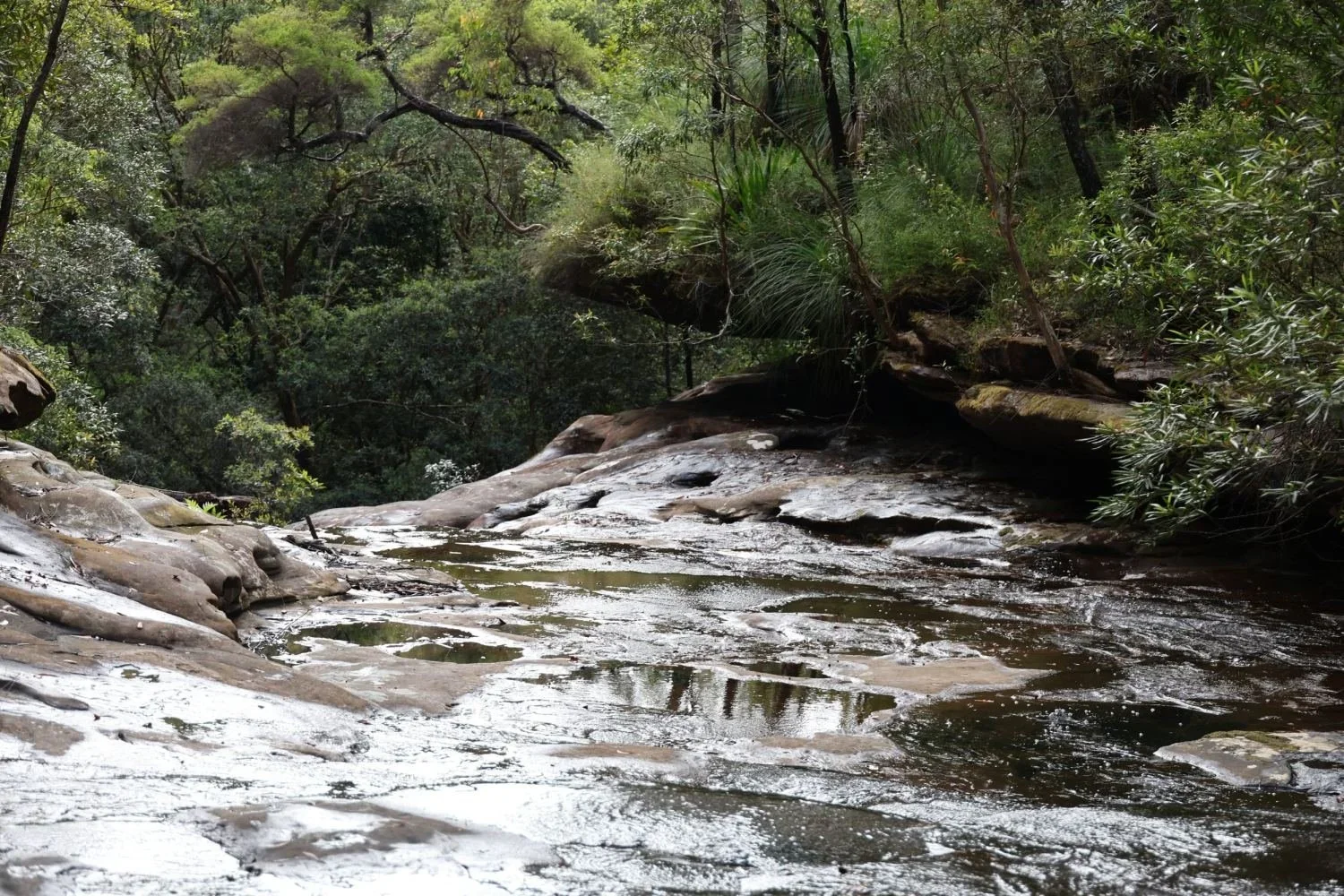
Sydney Nimble Tours recently visited a freshwater pool in the Royal National Park that we have not previously visited.

Sydney has recently had a few days of rain ensuring that the creeks in the Royal National Park have a good flow of water plus today’s weather was warm and sunny.

It’s all in the timing and our visit was rewarded with several refreshing swims in a peaceful bush setting.

If you want to hang out for a while a small nearby cave can provide shade from the strong summer sun.

goggles, not google, on show

new star mammal discovered

a nearby pool brought on a smile